For those who want to skip ahead:
- Vision makes decisions for you
- Build your marketing around your gift, not somebody else's script
- Give them the what AND the how
- Content is a third of the equation, not the whole thing
- Visibility beats readiness
- Teach your team the platform, don't outsource it
- The seven-step sequence, and the pushback it earned
- Get it in writing
- Give away enough to prove it, not enough to replace it
- What I'm still thinking about
- FAQ
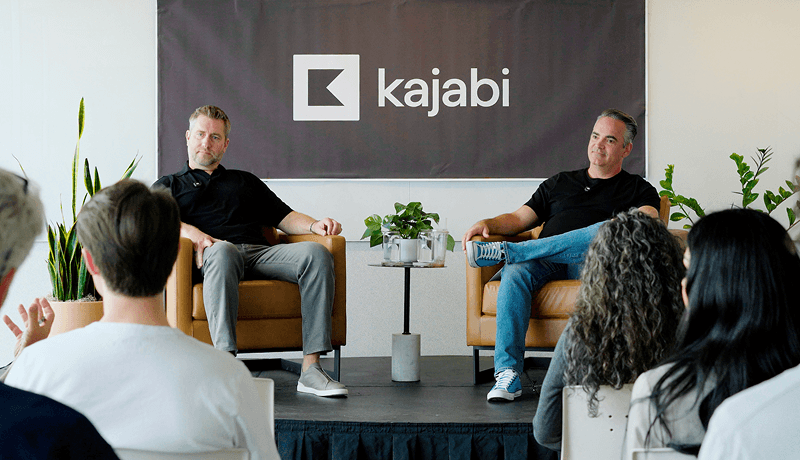
I hosted the third Council of Heroes webinar session on July 10th with two people I'm lucky enough to call friends: Adam Flores and Jen Blandos. People joined in from Dublin, Istanbul, Orlando, Hong Kong, the USA, and dozens of places in between, which is still the part of this job I don't take for granted. Watching the chat fill up with cities from six continents before we've said a single word of content is still the best five minutes of my week.
I've delivered 300+ hours of live webinars to Kajabi Heroes over the last (almost) five years, and before that I was sitting exactly where our attendees were. My team and I built a course in 2019 that did over half a million dollars in revenue, and I still remind myself constantly that whatever I've learned is peanuts next to what Adam and Jen have built. That's not false modesty. It's the entire reason The Council of Heroes exists: bring in the people who are actually doing it right now, hand them the microphone, and get out of the way.
Adam Flores is the founder of Smart Business Mastermind, and he's crossed $10 million in program sales teaching people to fill and convert rooms through virtual events and workshops. His clients typically sell offers, group programs, retreats, and memberships priced between $2,000 and $25,000, and his whole philosophy is built around a line he repeated a few different ways throughout the hour: money is just a sequence of ideas in your business, so when the ideas change, the results change, even if you're the exact same person underneath. He also dropped one of those lines that's so simple it sounds like a fortune cookie until you sit with it: if you think you're a mistake, you're mistaken. One attendee called it "so cute" in the chat in real time, and she wasn't wrong, it's the kind of line that's easy to dismiss until you notice how much of your own hesitation is built on exactly that belief.
Jen Blandos is a serial entrepreneur based in Dubai, originally from Canada and the UK, with 25-plus years building businesses, communities, and ecosystems across dozens of countries. Her flagship community, Female Fusion, started as a free Facebook group during the pandemic for women who'd lost jobs or clients and didn't know how to make money. That free group hit roughly 10,000 members before Jen turned it into a paid community. It crossed six figures in revenue within less than a year and seven figures within about 18 months. Five years later, Female Fusion is the largest business community in the entire Gulf region, and Jen still gets messages from members saying some version of "because of you, this changed my life." She told me that's the part that makes the hard days worth it, more than any revenue number.
Here are the 9 things that stuck with me, why I think each one matters more than it sounds like on the surface, and what the room actually said about them while it was happening.
A quick note before I get into the list. I've hosted enough of these sessions now to notice a pattern in what actually sticks with an audience versus what gets a polite nod and then evaporates by the next morning. The frameworks that survive contact with real business owners are almost never the ones that sound clever in isolation. They're the ones that map onto a decision you were already avoiding, and Adam and Jen delivered nine of those in a single hour, which is a genuinely unusual density for a panel this size.
1. Vision makes decisions for you
I asked both of them the same question I ask almost every panelist on this series: if you could go back to your first year on Kajabi, what would you tell yourself? Jen went first, and her answer was about pace. She told me her early mistake was moving too fast without thinking about scale, jumping in and building before she'd really considered what the business could become.
Her advice, in hindsight, was to slow down just enough to set things up strategically from day one, to ask "what if this actually becomes a seven or eight figure business" before you're three years deep into infrastructure you have to rebuild. She said it plainly: they rushed, and then they had to slow down anyway to rebuild things correctly. You can pay that tax up front or you can pay it later with interest.
But it's Adam's answer that became the line of the day, and the one I still haven't stopped turning over: one clear vision, one clear audience, one clear message, one clear offer.
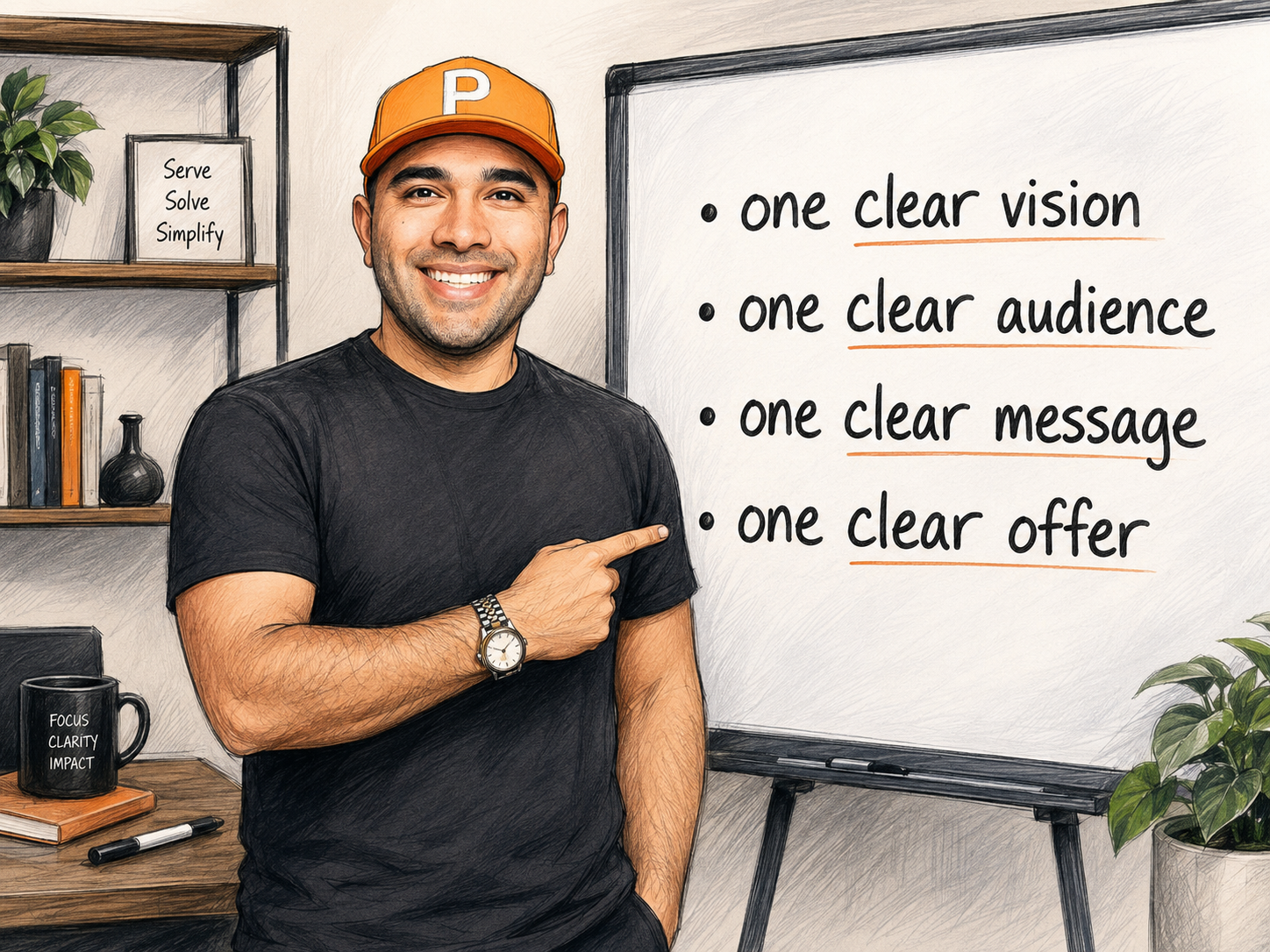
He told me his early mistake was chasing every new idea that came along and calling it inspiration. A new product idea here, a new funnel concept there, should he run a webinar or a challenge, should he build this thing or that thing. Building feels like momentum. It's actually avoidance, a way to stay busy instead of finding out whether the thing you've already built actually works.
Here's the part of his answer that I think gets missed if you just read the quote without the context around it. Adam wasn't describing a lack of discipline. He was describing a very specific, very human defense mechanism: building feels safer than shipping.
When you're building, you're still in the phase where everything is theoretically perfect. The moment you commit to one offer, put it in front of one audience, with one message, you open yourself up to finding out it doesn't work.
That's uncomfortable in a way that building a fourth funnel never is.
Adam's own words were that these patterns "can be survival mechanisms," and that we "pass them off as I'm just creating what I feel inspired to create," when underneath the surface, we're distracting or avoiding.
One attendee asked him to repeat the line mid-session, word for word, so she could write it down. That's usually how you know something is going to outlast the hour it was said in.
If you want a homework version of this lesson, it's this: write one sentence naming your audience, one sentence naming the single belief you want them to walk away holding, and one sentence naming the one offer waiting at the end. If you can't fill in all three without hedging, you're not behind on tactics.
You're early on clarity, and no amount of new funnels or new content formats will fix that particular gap.
2. Build your marketing around your gift, not somebody else's script
Adam's other early mistake, in his own words, was buying a downloadable webinar template from someone who'd made millions running it, then trying to pour his own message into that shape.
It never fit. It never does. This is one of those lessons that sounds obvious in a sentence and is genuinely difficult to internalize in practice, because the entire online education industry is built on selling you somebody else's proven structure.
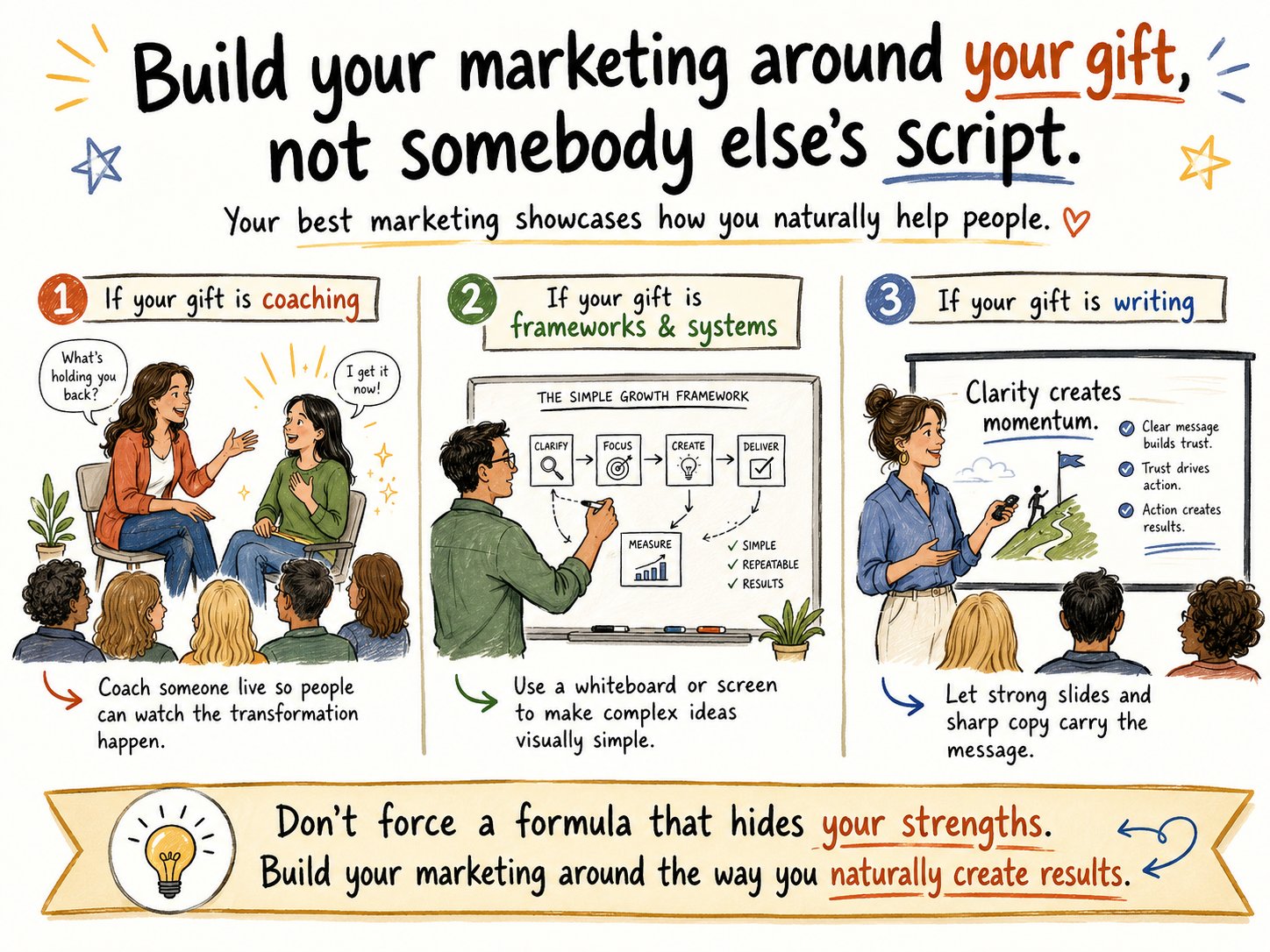
His advice runs the opposite direction: build your webinar, and honestly your whole business, around your actual gift. He broke this down into three rough categories during our conversation, and I want to spend a minute on each because I think most people only hear the first one and miss the other two.
- If you're naturally gifted at coaching, your event should feature you coaching somebody live, in front of the room, so people watch the transformation happen in real time instead of hearing you describe it in the abstract.
- If you think in frameworks and systems, your event should be built around a whiteboard or a shared screen where you're drawing out the architecture of the idea, because your gift is making complex things visually simple, and a slide deck full of bullet points buries that gift instead of showcasing it.
- If you're a strong writer, your event should lean on slides and copy that let your language do the heavy lifting, because that's where your actual skill lives.
The mistake almost everyone makes is skipping this self-assessment entirely and instead asking "what's the format that worked for the person I'm following." Adam's phrase for this, and I think it's the most quotable thing he said all day, was: "It's never about getting you to try to be like me. It's about you becoming like you." If you copy somebody else's structure because it converted for them, and you end up sounding like a knockoff of yourself, competing on their strengths instead of yours.
He also pointed out something that a lot of coaches don't say out loud: a lot of frustration in this industry comes from people buying a system, discovering their gift doesn't fit inside it, and concluding they're bad at this, when the real problem was never them. It was the system.
Someone in the chat summed up the practical impact of this better than I could have: aligning with your gift takes a ton of friction out of your whole business. Another attendee said that single point alone was worth the entire session, which is a big claim for an hour that covered nine other things, but I understood exactly why she said it.
Once you stop trying to perform somebody else's format, everything downstream gets easier, your content creation, your energy on camera, even your close rate, because you're not spending half your effort fighting your own instincts.
If you're building this out inside Kajabi, this is exactly why the platform supports so many different content and delivery formats under one roof instead of forcing you into a single template. A coach who wants to run live coaching calls as the core of their offer needs different tools than a strategist who wants to hand people a framework and a workbook, and a writer who wants to build a beautifully designed, copy-forward sales and course experience needs something else again.
The point isn't which format is best. It's that your platform shouldn't be the thing deciding your format for you. Your gift should.
3. Give them the what AND the how
Adam has a name for a pattern he sees constantly in this industry, and it's a phrase I've already started using myself: a trust recession. Most webinars teach the what and deliberately withhold the how, then spend the last twenty minutes pitching a program that finally promises to hand over the missing piece.
It's an old playbook, and audiences have caught on to it. You can feel it in how guarded people are before you've even said a word, because they've sat through this exact structure a hundred times before and they're waiting to be sold to instead of taught.
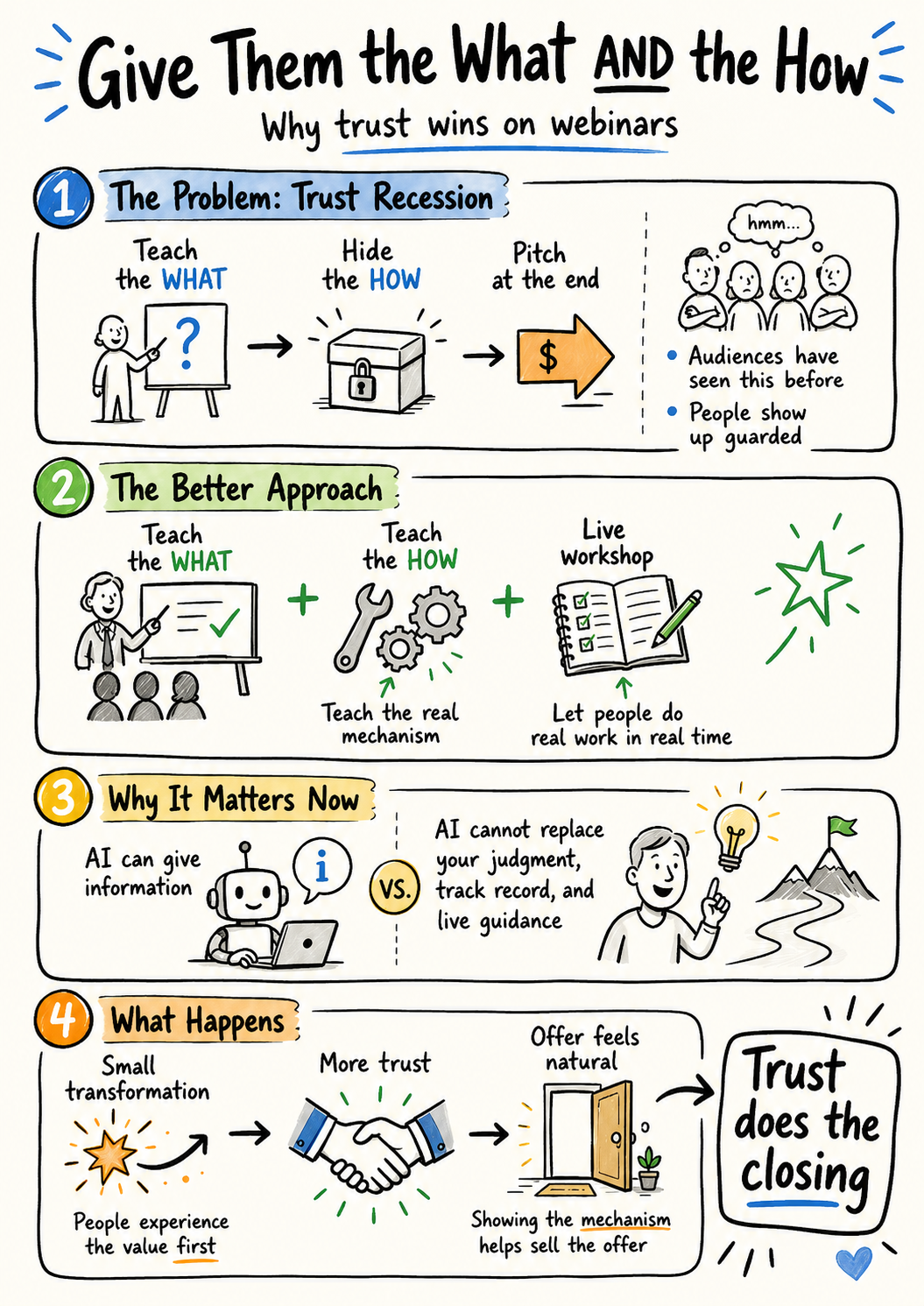
His version runs the opposite way, and it's a genuinely uncomfortable idea for a lot of experts the first time they hear it: teach the real mechanism, live, on the free call.
Not a watered down preview. Not three tips designed to create just enough curiosity to justify a pitch. The actual thing.
Jen added a piece here that I think completes the picture: treat the hour like a workshop where people do real work on themselves in real time, not a lecture they sit through before the ask. Give them something to build, write, or decide during the session itself, so by the time you make the offer, they've already experienced a small transformation, not just absorbed information.
Here's why I think this matters more now than it would have five years ago. We're living through a moment where AI can generate a passable answer to almost any question somebody would ask on a free webinar. If your entire value proposition is "I have information you don't," that moat evaporated sometime in the last two years.
What AI cannot generate is your actual track record, your judgment built from doing the work thousands of times, and the real-time experience of someone who's solved this exact problem walking you through it live. Adam's approach only works, at scale, because he's betting on the fact that showing the real mechanism doesn't cannibalize the offer. It sells it.
By the time you make the offer, nobody's wondering if you know what you're doing. They already spent an hour finding out, which is a completely different psychological position than wondering.
One attendee in the chat said she'd already written her own book about rebuilding trust with clients, and that the phrase "trust recession" stuck with her the moment Adam said it. Another put her own version of the same idea in the chat in real time: she doesn't close people anymore, they come to her, because she gives away enough that trust does the closing for her, and she said she's never had to run a hard close in her business as a result.
That's not a coincidence. That's the mechanism working exactly the way Adam described it.
4. Content is a third of the equation, not the whole thing
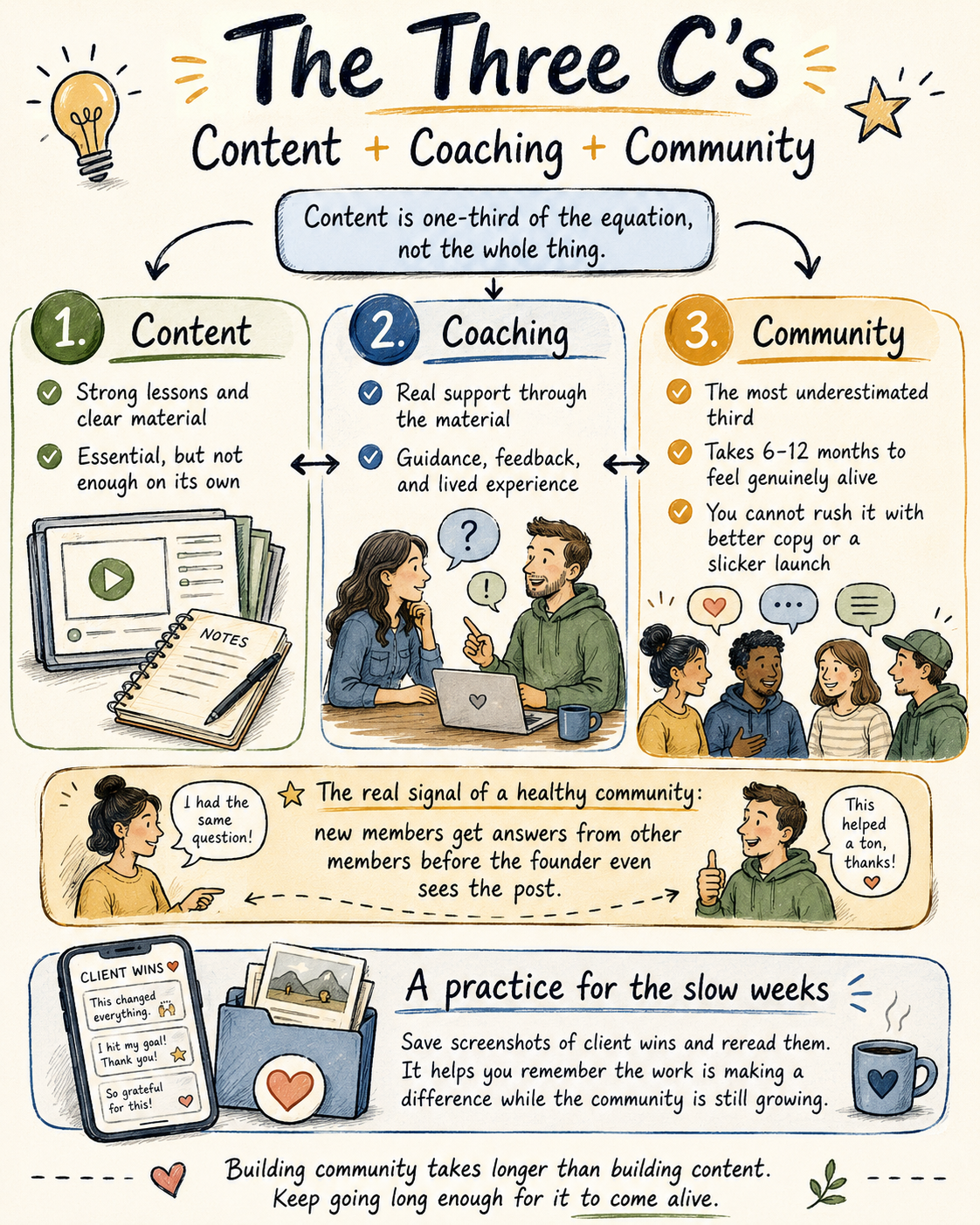
Adam's framework here is what he calls the three C's: content, coaching, and community. But for a long stretch of his career, he believed that if the content was good enough, the community would basically build itself, that people would show up, buy in, and start supporting each other purely because the material was strong enough to inspire it.
He told me, with more honesty than most people bring to this kind of admission, that the belief was really a way to avoid the risk of putting something imperfect into the world and finding out it didn't land the way he hoped.
Content is one third of a program that actually works. Coaching, the real support and lived experience of working with people through the material, is another third. Community is the last third, and it's the one people most consistently underestimate, because it doesn't show up in a course outline the way modules and lessons do. Community takes six months to a year to feel genuinely alive, no matter how good the content underneath it is, and there's no way to compress that timeline through better copywriting or a slicker launch sequence.
Here's how Adam knows a community has actually crossed the threshold. It's not a revenue number or a member count. It's the moment new members start getting their questions answered by other members before Adam or his team ever sees the post. That's the signal that the thing has become bigger than the founder, which is both the goal and, for a lot of experts, a strange thing to let go of wanting control over.
One detail he shared that I genuinely loved, and that I think about more than almost anything else from the conversation: during the slow stretches, the weeks where the business doesn't feel like it's working, he screenshots client wins and rereads them. Not to build a highlight reel for marketing. To remind himself, privately, that the thing he's building is actually making a difference, especially on the days when the feedback loop from the business itself doesn't make that obvious.
I think every expert running a program, community, or course should have some version of this practice, because the gap between "day 40 of building a community" and "the community actually works" is long enough that you need something more durable than momentum to get you through it.
This is exactly the gap Kajabi's Communities feature is built to close, giving your members a real space to answer each other's questions, run their own conversations, and build the kind of peer-to-peer momentum that eventually makes a founder's daily presence optional instead of mandatory.
If you've been running your community bolted onto a Facebook group or a separate app from your course content, this is usually the first thing worth fixing, because content, coaching, and community living in three different places make it three times harder for any of them to reinforce the other two.
5. Visibility beats readiness
I asked both of them a version of the same question: what would you tell somebody who has the expertise, the knowledge, maybe even an existing audience, but hasn't figured out how to turn any of it into an actual business.
Jen went first, and her answer was to "Stop waiting to feel ready." She talked about how often she meets genuinely experienced, capable people who want to do exactly what she's done, and the thing holding them back isn't a skill gap, it's fear.
She said people are plagued with internal dialogue like:
- What if people laugh at me?
- What if nobody's interested?
- What if my skills aren't good enough compared to everyone else already doing this?
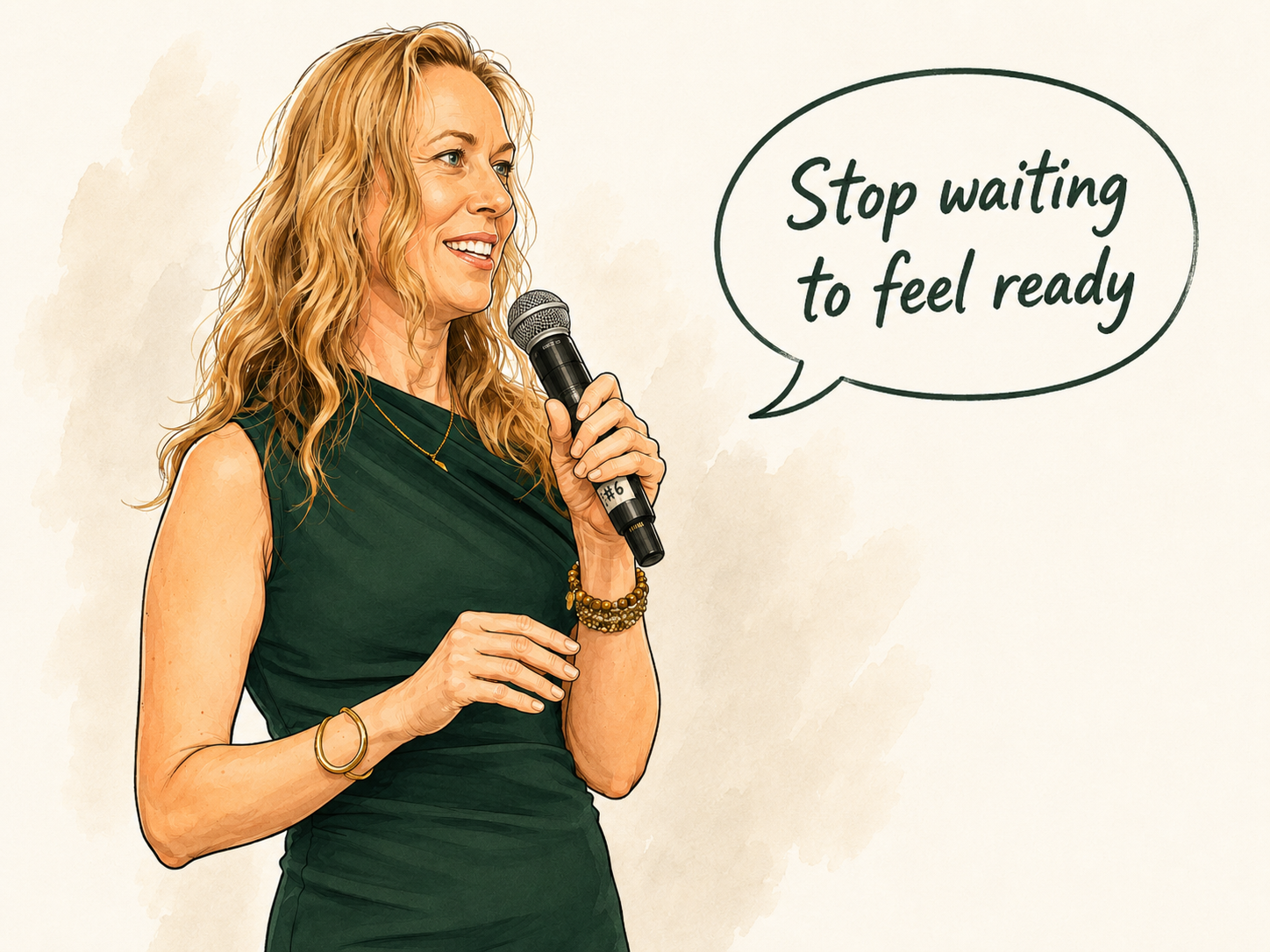
Her concrete advice: start a free monthly webinar with no offer attached. Don't charge for it. Don't even build an offer to pitch at the end, at least not at first. Show up, and actually listen to the questions people are asking you, because that's simultaneously market research and confidence building at the same time.
The moment you've done that a few times, something shifts, and you go from wondering if you actually know anything to realizing you clearly do, because you just spent four straight sessions answering real questions from real people without running out of things to say.
Jen practices this exact approach on LinkedIn, and it shows. One attendee said as much directly in the chat, almost as an aside: people get interested in you based on what you post and comment on, and she thanked Jen for putting that observation into words.
I'll add my own observation here, since I follow Jen's activity too: she is genuinely everywhere in the comments section of other people's posts, not just her own feed, which is a much less obvious but arguably more powerful version of visibility than simply posting on your own page and waiting. Showing up in other people's conversations and adding something useful is a form of borrowed reach that costs nothing.
A few reps into showing up like that, Jen said, and you stop wondering if you know enough. You start realizing you already did, and the entire blocker was never a knowledge gap.
6. Teach your team the platform, don't outsource it
This one genuinely surprised me, and I've been doing this job for five years. Jen doesn't hire outside tech help for anything in her business. Every single person on her team, and she does have full-time staff, knows how to build a landing page, run an email sequence, and manage funnels inside Kajabi. All of it. Nobody on her team is a specialist who only touches one piece while everything else routes through an outside contractor.
The mechanism behind this is more deliberate than it sounds. Building the standard operating procedure for whatever a team member owns is literally part of their KPIs. It's not an optional nice-to-have that happens if there's spare time at the end of the quarter. It's a measured expectation of the role. And she keeps every single one of those SOPs inside an actual course, built on Kajabi itself, specifically for her own staff to reference. New hires don't learn the business through tribal knowledge passed down in Slack threads. They learn it through a structured internal course the same way a paying member would learn Jen's actual content.
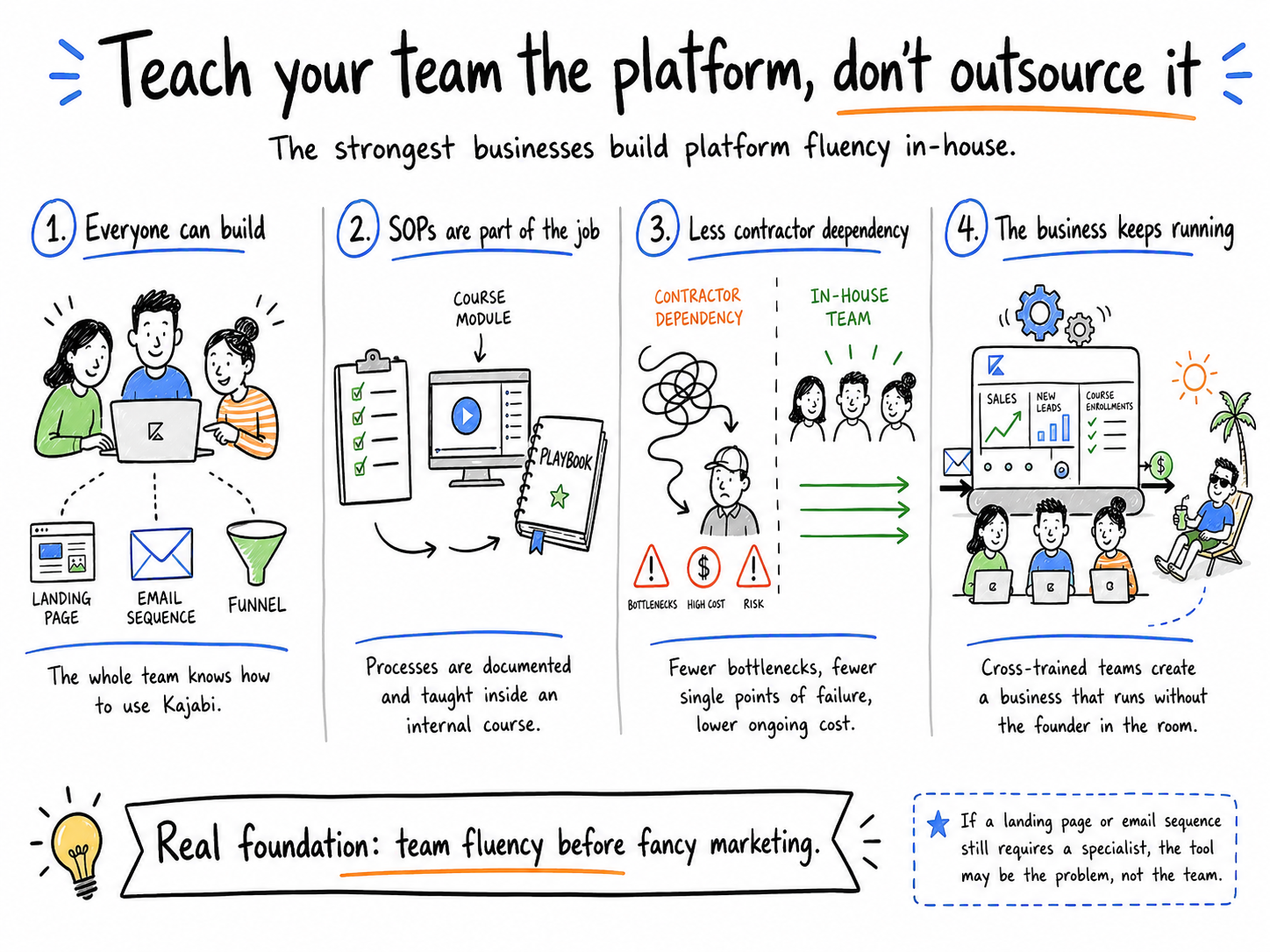
It sounds like overkill until you think through what it actually buys her. A business that depends on outside contractors for its core operations is a business where every contractor relationship is a single point of failure, a scheduling bottleneck, and a recurring cost that scales with your growth instead of your team's actual capability. A business where the whole team is platform-fluent, documented, and cross-trained is a business that keeps running whether Jen is in the room that day or not, which is the actual definition of a business you own versus a job you've built for yourself.
The question that got her to this answer came almost word for word from one of our attendees: "what's the single most important thing to have in place from day one if you want to build a community that actually holds together long term?" I expected her to answer with something about content strategy or engagement tactics. She didn't. Team fluency with the platform was her answer before she said a single word about content or marketing, which tells you something about where she thinks the real foundation of a durable community actually lives.
This is, not coincidentally, one of the specific problems Kajabi's Cofounder AI and our broader platform design are meant to solve, lowering the technical floor so that "the whole team should be able to build inside the platform" is a realistic standard instead of an aspirational one reserved for technically inclined founders. If building a landing page or setting up an email sequence still requires a specialist on your team today, that's usually a sign of the tooling, not a sign that your team lacks the capability.
7. The seven-step sequence, and the pushback it earned
Adam's favorite story about marketing has nothing to do with marketing on the surface. It's about the day he got talked into buying a piece of imported Swiss chocolate at a mall kiosk for roughly eighty dollars, which by his own account is an absurd amount of money for chocolate, and which his wife has since been banned from revisiting on her own. He walked through the entire interaction step by step, because once you break it down, it maps precisely onto every high-converting webinar funnel he's ever run.
First, a pattern interrupt. Someone stopped him mid-walk through the mall: excuse me, sir. Second, a bold promise: the finest chocolate imported from Switzerland. Third, the giveaway: would you like to try a piece for free. Fourth, the bridge: an invitation into the store itself, not just a sample handed over in the hallway. Fifth, the tour: here's how we actually make this, here's what makes it different from the chocolate you can buy anywhere else. Sixth, the payday: the actual sale. Seventh, repeat, because the same person working that kiosk runs this exact sequence on the next person who walks by thirty seconds later. I actually typed this whole sequence into the chat in real time during the session, because people were writing it down that fast and we wanted to make sure nobody missed a step.
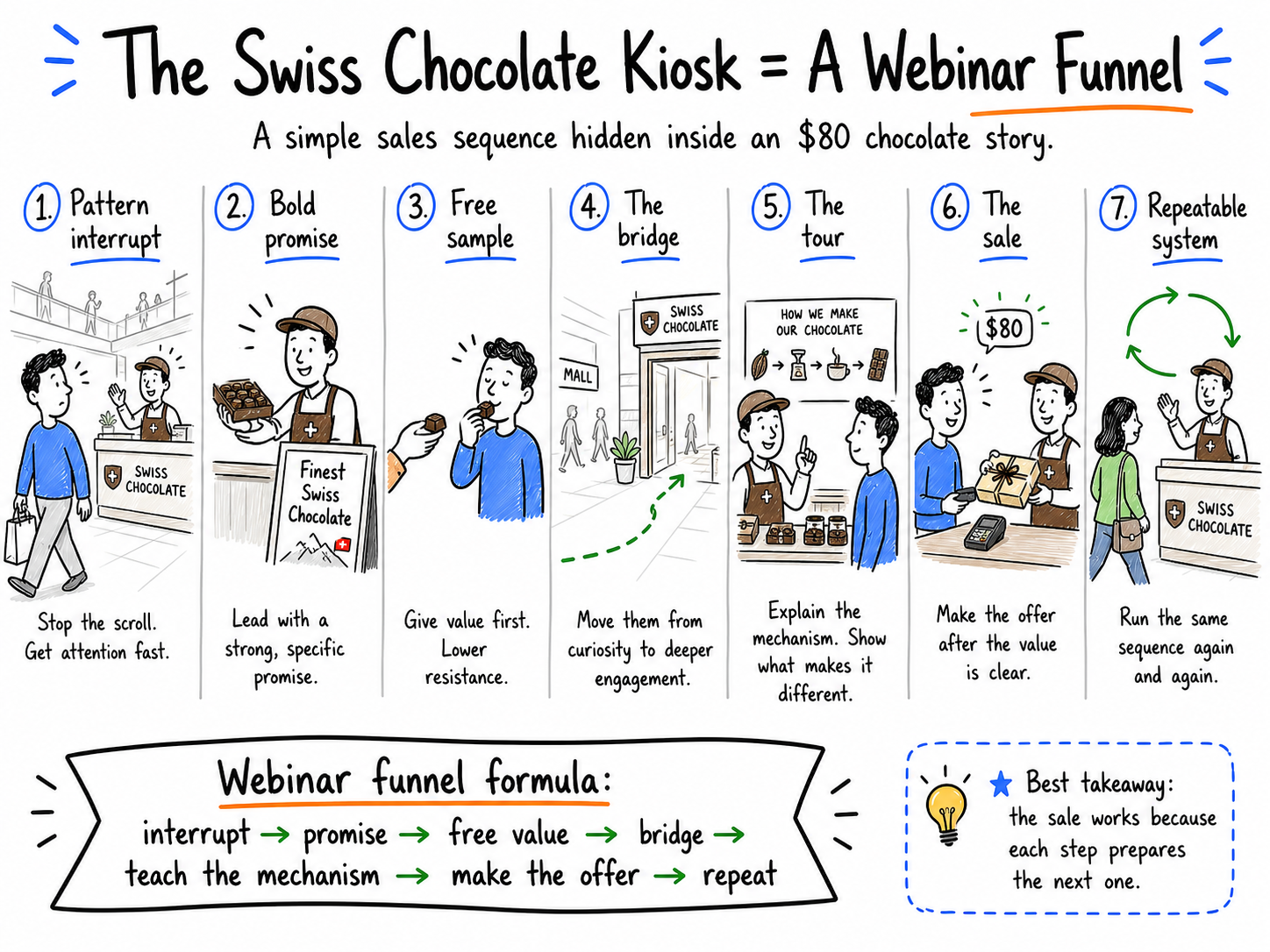
Adam runs that same seven-step sequence to fill his live events, instead of dropping a cold landing page link into a post and hoping enough of the right people click it. A pattern interrupt on social media. A bold, specific promise instead of a vague one. A giveaway that, in his case, is a guest pass to the actual event rather than a generic newsletter opt-in, because a guest pass feels personal and warm in a way a form field never does. A bridge into the event itself. A tour that is, in practice, just the real value of the content delivered live. Then the offer. Then repeat, every single day, because one good sequence run once fills one event, and the same sequence run daily builds a business.
Pair that sequence with what he calls 25 by 12: twenty five direct outreach messages a day, sent to real prospects, completed before noon. Not posts into the void. Direct messages, direct invitations, direct pitches to podcasts, sent to specific people. It's a system precisely because it's trackable. You either sent twenty five messages before noon or you didn't, and there's no ambiguity to hide behind the way there is with "I posted some content this week." The reason this matters at all is that a marketing plan built entirely on organic content leaves you completely at the mercy of an algorithm that owes you nothing and can change its mind about your reach overnight. Outbound doesn't have that vulnerability, because it doesn't depend on anyone's feed deciding to show your content to anyone.
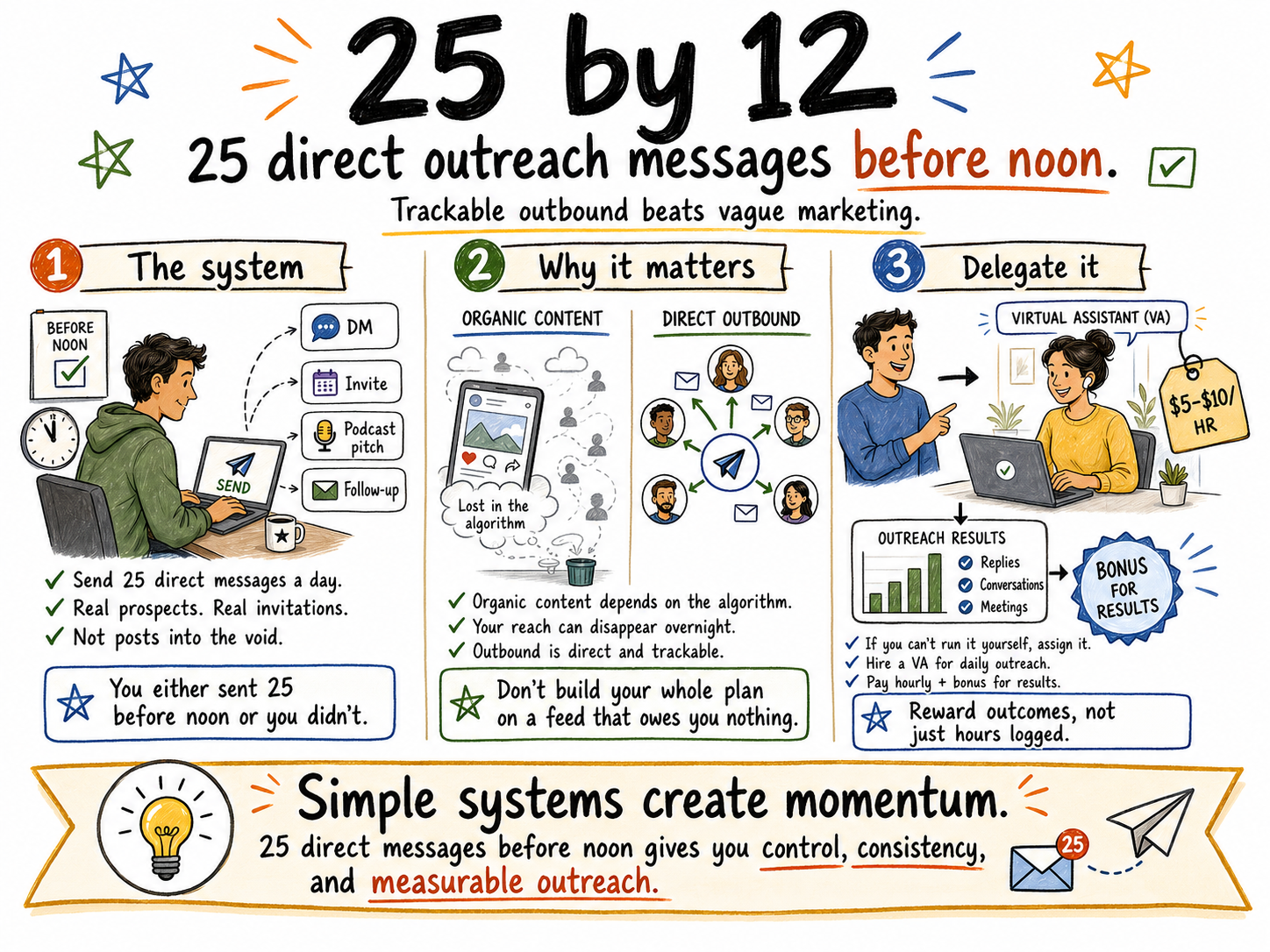
Not everyone in the room loved this idea right away, and I want to give that reaction real space instead of glossing over it. One attendee pushed back live, directly: doesn't twenty five messages a day feel spammy? It's a completely fair question, and I don't think there's a clean, tidy answer beyond this: the difference between outreach and spam isn't the quantity, it's the relevance. Twenty five thoughtful, specific invitations sent to twenty five different prospects who plausibly want what you're offering is a fundamentally different act than twenty five identical copy-pasted pitches blasted at strangers who've never expressed any interest, even though the math looks the same on a spreadsheet. If your version of 25 by 12 requires you to stop thinking about the individual human on the other end of each message, that's the actual problem, not the number twenty five itself.
If you genuinely don't have the time to run this yourself, Adam's answer wasn't to skip it. It was to delegate it. He hires virtual assistants for five to ten dollars an hour to run the daily outreach on his behalf, then bonuses them against actual results rather than just hours logged. He shared the exact moment this shifted for him: his first millionaire mentor once asked him why he was stuck at six figures. He didn't know. She told him it was because he woke up every single day asking himself how he could generate a lead today. That, she said, is a six-figure question. The seven-figure question is entirely different: who can generate a lead for me. Learning to ask the second question instead of the first is, in Adam's telling, the actual dividing line between the two income brackets, far more than any tactic or platform choice.
8. Get it in writing
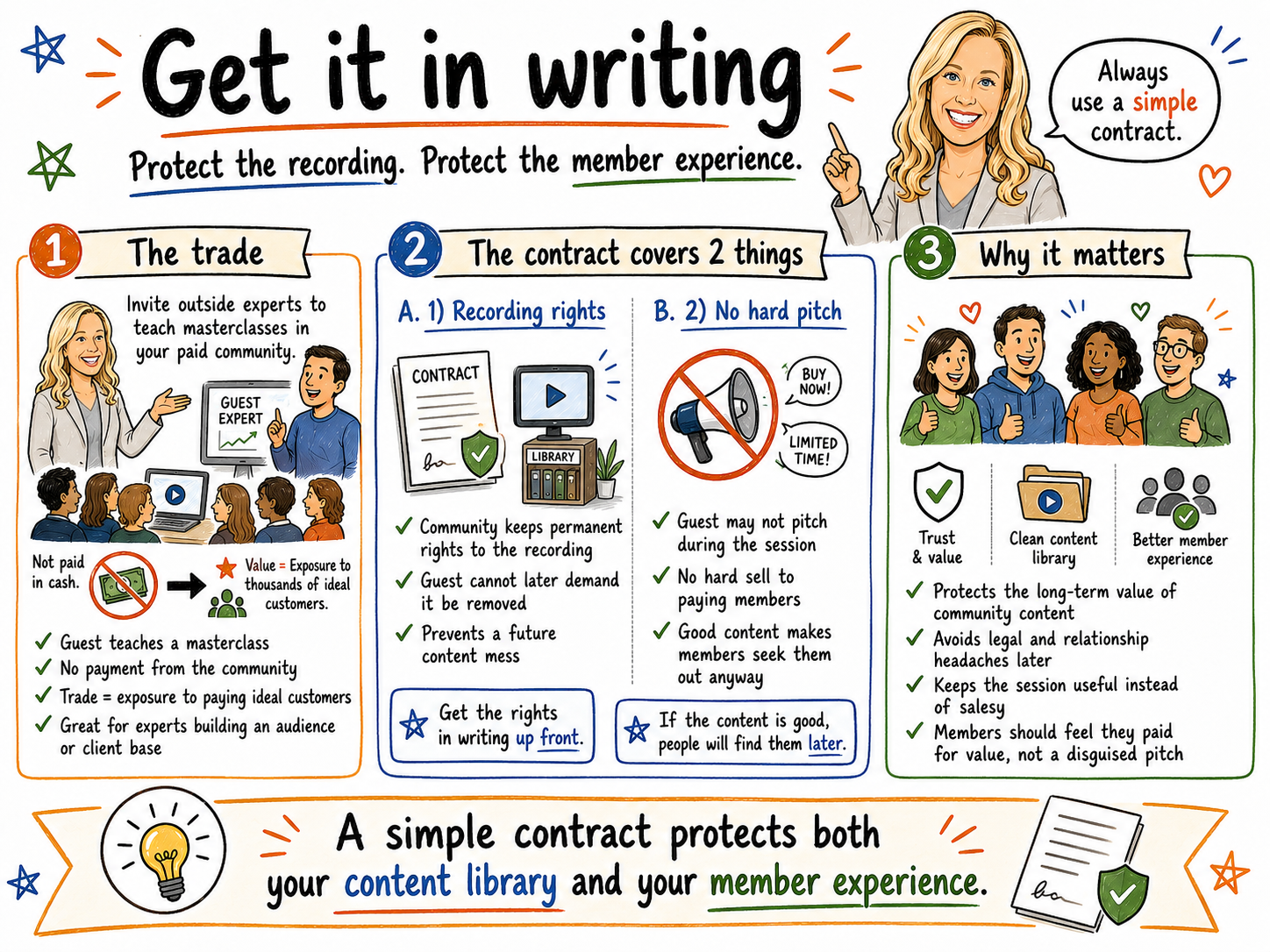
Jen doesn't pay the outside experts who teach masterclasses inside her paid community. The trade, instead, is exposure to thousands of already paying, already ideal customers, which functions as its own kind of currency for someone building their own audience or client base. But she learned, the difficult way, to have a lawyer draw up a simple contract before anyone gets access to her members, and the contract covers exactly two things.
First, the community keeps the rights to that recording permanently, regardless of what the guest later decides. Jen explained that she's heard from other community owners who had a guest have a change of heart months or years later, demand their content be pulled down, and create a genuine mess for a community that had built ongoing value around that piece of content. Getting the rights in writing up front means that scenario simply can't happen.
Second, the guest isn't allowed to pitch or run a hard sell during their own session. Jen's logic here is worth sitting with: if the content the guest delivers is genuinely good, her members will seek that person out afterward anyway, without needing a forced pitch at the end. Forcing a sales pitch into a session that members are already paying to access, from someone who isn't even being paid by the community, creates exactly the kind of experience that makes people question what they're paying for in the first place.
More than one attendee brought this exact topic up during the Q&A, and one of them explained precisely why the question mattered so much to her personally. She'd left an entirely different paid community because she kept getting asked, repeatedly, to lead sessions and answer other members' questions for free, essentially working as an unpaid moderator, while the person actually running the community continued collecting membership revenue for the value her free labor was creating.
That's precisely the dynamic Jen's contract structure is built to prevent, and it's worth noticing that it protects both sides of the arrangement, not just the community owner. The guest is protected because their content can't be unilaterally pulled or repurposed against their wishes. The community is protected because it has a stable, permanent library of content it can keep building value from. And members are protected from ever feeling like a session they paid for was secretly a lead-gen funnel for somebody else's separate offer.
If you're building any kind of guest-expert program inside your own community, whether that's paid masterclasses, guest workshops, or partner takeovers, this is the exact template worth copying before your first guest session, not after your first conflict.
9. Give away enough to prove it, not enough to replace it
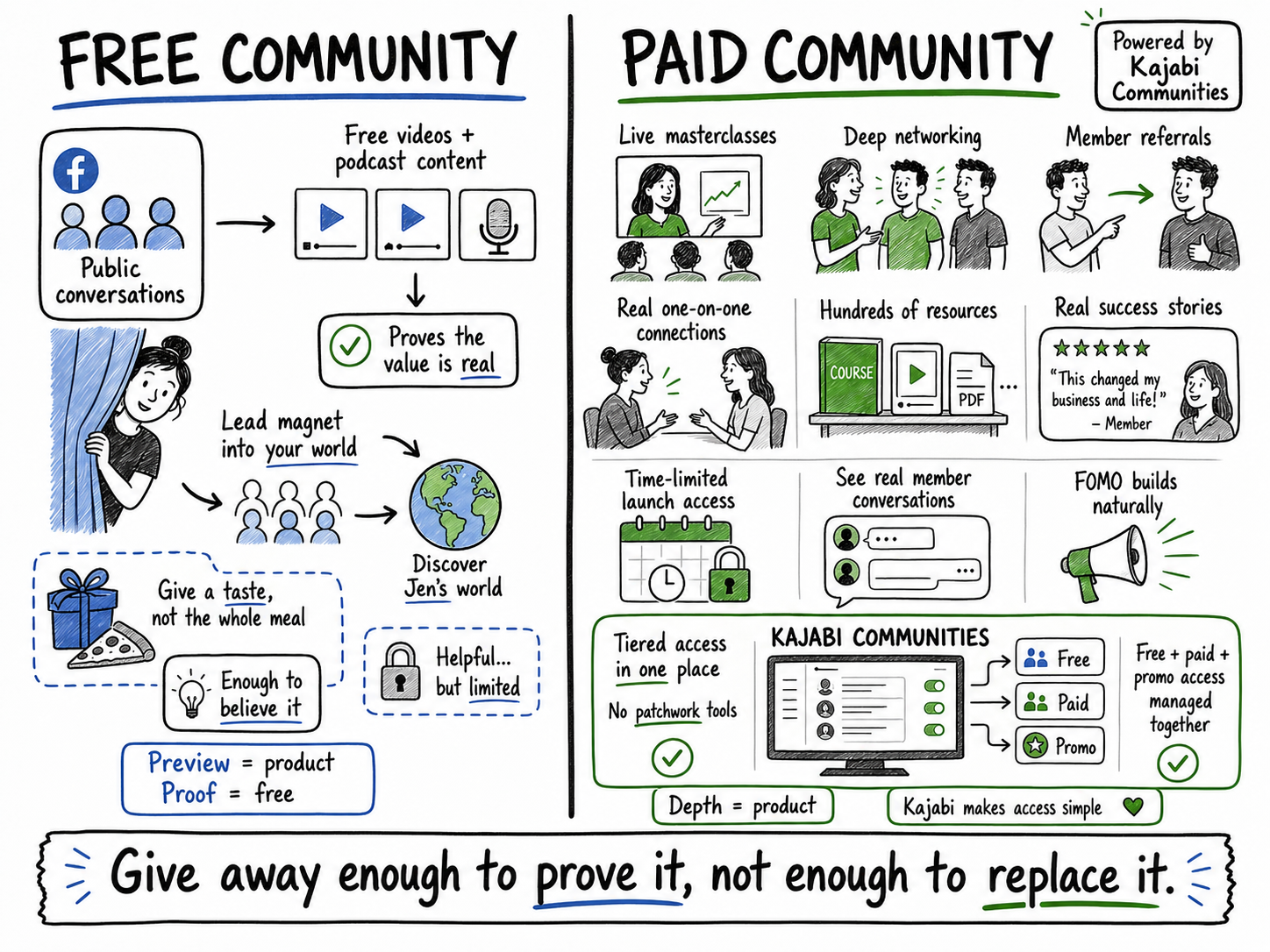
Jen's answer to the question of what stays free and what stays paid was more art than formula, and I appreciated that she didn't try to dress it up as a clean rule, because it isn't one. The general principle is this: show enough behind the curtain that people genuinely believe the value inside is real, without giving away so much that the paid experience feels redundant.
In practice, that means keeping a free community, in her case still running alongside the paid one on Facebook, as a kind of lead magnet into her broader world, offering a handful of free videos and podcast content that demonstrates the quality of her thinking. But the highest value pieces, the real one-on-one connections, the referrals between members, the live master classes, the deep networking, stay firmly behind the paywall, even while she talks about those benefits openly in public so prospective members build genuine FOMO about what they're missing.
Around launches specifically, she'll open a curated, time-limited slice of the paid experience to prospects, something like ten master classes and four or five templates pulled from a much larger library of hundreds, plus temporary access to the actual paid community itself. That temporary access matters more than the content alone, because it lets a prospect see real, current member conversations, real success stories being shared in real time, and the actual texture of the community they're considering joining, rather than just reading a sales page describing what it's like from the outside.
One attendee explained, with real specificity, exactly why getting this balance right matters so much. She'd joined a paid community built by someone she'd followed and trusted on YouTube, and left almost immediately, because the entire membership experience turned out to be one long, continuous hard sell disguised as content. Jen's entire model exists specifically to avoid becoming that. The whole point of proving value before asking for money is that it makes the eventual ask feel like a natural next step instead of a trap you walked into by accident.
If you're managing this balance today across a patchwork of a Facebook group, a separate paid platform, and a checkout tool that doesn't talk to either one, Kajabi's Communities feature is built specifically to handle tiered access in one place, free content, paid content, and time-limited promotional access, without needing three separate systems to manage who sees what and when.
What I'm still thinking about
Two friends, one Friday morning, and I still left with a full page of notes despite already knowing pieces of both of their stories going in. One attendee summed up the entire hour better than I could, right as we wrapped: "some good gold nuggets in there". That's the whole premise behind Council of Heroes. The people who've actually built the thing say it better, more specifically, and more usefully than any framework I could write from the sidelines, and my job as the host is mostly just to get out of the way and ask good questions.
If any of this is resonating and you're sitting on expertise, an audience, or a half-built webinar funnel that hasn't quite clicked yet, this is exactly the gap Kajabi is built to close. Kajabi's Communities feature handles everything Jen described: tiered free and paid access, moderator roles, guest contributor management, all inside the same platform your content and courses already live on. Our funnels handle the registration page, the anticipation-building emails, the event itself, and the follow-up sequence Adam described, running as one connected system instead of six separate tools you're stitching together by hand. And if you're earlier in the journey and just trying to get your first free monthly webinar off the ground the way Jen described, our Cofounder AI is built specifically to lower the technical floor so building any of this doesn't require a developer or a specialist on your team.
Whatever stage you're at right now, see a full walkthrough of Kajabi and how the platform brings webinars, communities, and everything Adam and Jen described today into one place, instead of a stack of tools that were never designed to talk to each other in the first place.
Thanks again to Adam and Jen, and to everyone who showed up and made the chat impossible to keep up with.
Frequently asked questions
What is the Council of Heroes?
The Council of Heroes is Kajabi's monthly live panel webinar, held on the third Friday of every month. Instead of one instructor teaching a single lesson, it puts a rotating group of successful builders in the room to break down what's actually working in their businesses right now, then opens it up to live Q&A. This piece covers the third session, featuring Adam Flores and Jen Blandos.
Who is Adam Flores?
Adam Flores is the CEO of Smart Business Mastermind, where he teaches entrepreneurs how to fill rooms and convert attendees into paying customers for high-ticket virtual events. He's crossed $10 million in program sales, and his clients typically sell offers priced between $2,000 and $25,000. His focus is the actual mechanics of turning a webinar or workshop into a fully booked, revenue-generating event.
Who is Jen Blandos?
Jen Blandos is a serial entrepreneur and community builder based in Dubai, with 25-plus years of experience building businesses and communities across 78 countries. She's best known for Female Fusion, which she grew from a free pandemic-era Facebook group into the largest paid business community in the Gulf region, now more than 60,000 members strong.
What is a trust recession?
A trust recession normally describes a broad decline in confidence across institutions and brands, a term that's been circulating in marketing and business writing since around 2021. Adam applies it more specifically here: what happens when a webinar teaches the what but hides the how, saving the real answer for a pitch at the end. Audiences have caught on to that pattern, and they show up guarded because of it. His fix is to teach the actual mechanism live and for free, so trust does the selling instead of a hard pitch.
What is Kajabi?
Kajabi is an all-in-one platform for building and selling a knowledge based business: courses, coaching, memberships, communities, podcasts, and newsletters, all in one place instead of stitched together from five different tools. Experts have earned more than $11 billion on the platform across over 100,000 businesses built.
Who is Kajabi for?
Kajabi's built for people whose knowledge comes from real experience: coaches, consultants, educators, clinicians, and service professionals who want to turn what they know into an actual business. If your work helps someone else get a result, Kajabi's built to support that.
Is Kajabi good for beginners who want to grow into a larger business?
Yes. You can start with a single product and expand into courses, coaching, communities, and memberships without switching platforms as you scale. That's basically Jen's advice earlier in this piece: the mistake is building fast without thinking ahead, then having to rebuild everything later. Kajabi's built so you don't pay that tax twice.
The Author

Alex Veng is a Senior Customer Engagement Specialist at Kajabi, where he helps Experts turn their knowledge into digital products, marketing strategies, and scalable online businesses. Before joining Kajabi, Alex generated over half a million dollars using the platform, giving him firsthand experience with the same challenges Experts face when packaging their knowledge, attracting an audience, and making consistent sales. Over the past four years, he has led hundreds of live webinar sessions, taught for more than 350 hours in live training environments, answered hundreds of real customer questions, created practical video guides, and spoken on stages about the future of digital business, AI-powered content, and the expert economy. His perspective is shaped by both real-world execution and thousands of conversations with Experts trying to turn what they know into income.