Jump to a section
- What actually changed in 2026
- Step 1: Validate demand before you build a thing
- Step 2: Price against the outcome, not the hour
- Step 3: Build the smallest course that overdelivers the result
- Step 4: Choose where your course lives
- Step 5: Launch with a sequence, not a single email
- Step 6: Turn student wins into your next launch
- Step 7: Borrow while you build an audience you own
- Where most course launches die
- FAQ
Who's writing this: I've delivered 300+ hours of live webinars to Kajabi customers, the people we call Heroes, and answered thousands of real questions from experts building and selling courses. This is the pattern I see separating the courses that sell from the ones that quietly die.
Who this is for: experts, coaches, consultants, and educators who want to package what they know and sell it. First course or fifth, the playbook is the same. The order is what most people get wrong.
The short version
Creating and selling an online course in 2026 comes down to seven strategic steps, in order: validate that people will pay before you create anything, set the price by the result your course delivers, build the leanest version that actually gets the result, put it on a platform that sells for you, launch to a warm audience with a real email sequence, turn your first students into the proof that fuels your next launch, and from the start, borrow other people's reach while you grow an audience of your own.
Get the order right and the rest gets easier. Get it wrong and no amount of production polish saves you.
Notice what's not on that list.
- Camera gear ❌
- Production crew ❌
- High priced video editors ❌
- A 40-lesson curriculum ❌
- A perfect niche ❌
Those are the things outdated guides and gurus with rented lamborghinis obsess over, and they're the reason most first courses never sell. It's important who's advice you take in these early stages, the general rule of thumb is to assess how that person turns a profit, meaning if they make money selling you a course on how to create a course... be cautious.
It's better to learn from someone who's done it before and is outside of the "make money online" niche.
In this guide, I'll lay out the seven steps for you, based on my own experience selling courses + behind the scenes access to over 100,000 businesses that use Kajabi to do it.
What actually changed in 2026
It's worth pointing out that most "ultimate guides" you may read on this topic were written for a different internet and to profit from your curiosity.
They tell you to buy a green screen, pick a broad subject, and record until it looks professional. That advice made sense when having organized, well-produced information was rare enough to charge for.
It isn't rare anymore.
AI will now draft a course outline, write the slides, and generate a script in the time it takes to read this paragraph. Your prospective student can ask a chatbot the same question your course answers and get a passable reply for free.
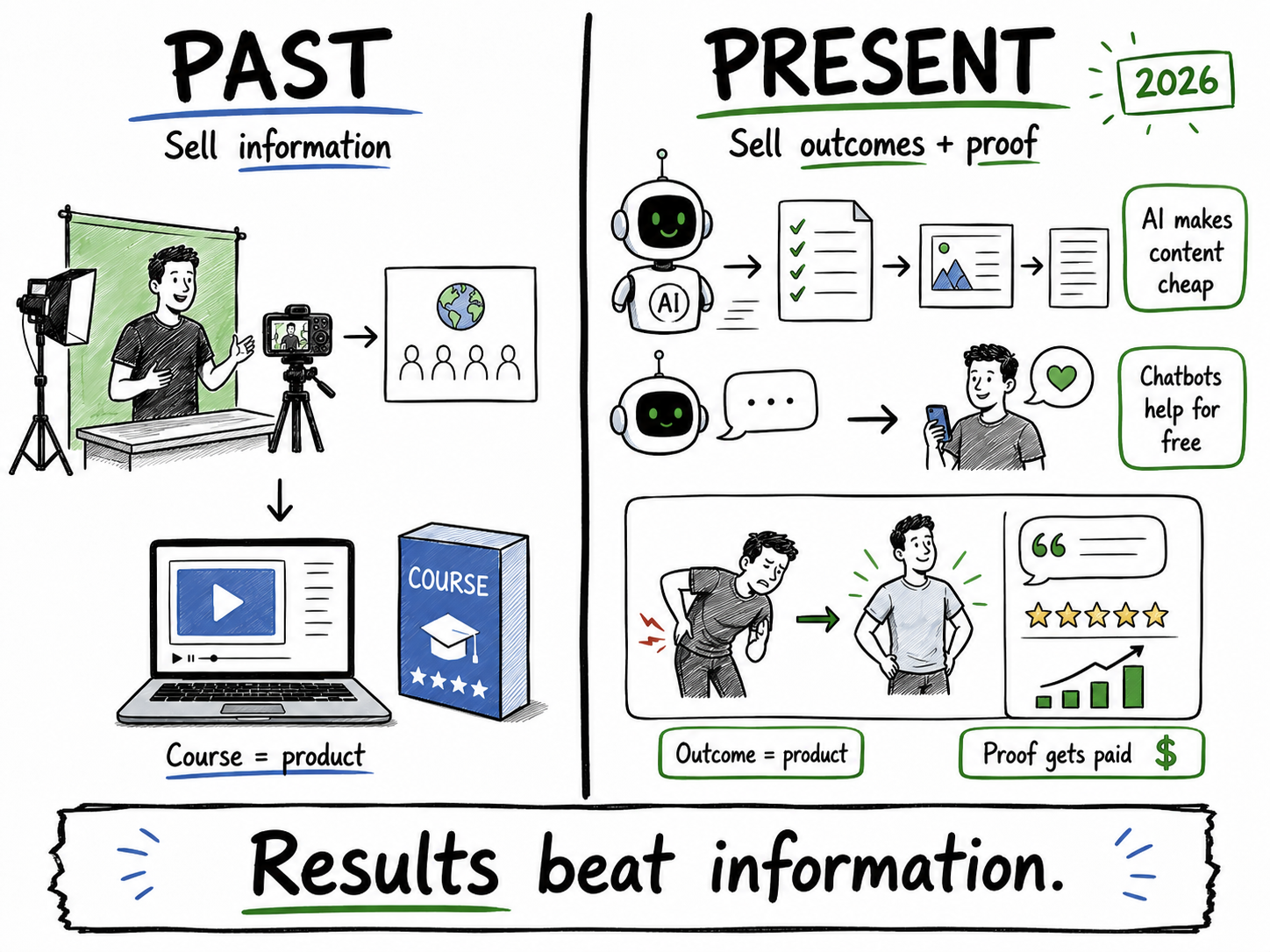
So the thing people used to sell, "packaged information," is now the cheapest part of the equation.
Here's what that means for you... the course is no longer the product.
The outcome is the product, and the proof that you can deliver it is what people actually pay for.
A back pain specialist who's helped thousands of real people move without pain has something AI can't generate: a track record.
That's the moat now.
This is why we talk about the expert economy. Making content is one thing, and AI makes it cheap. Getting people a result and being able to prove it is another, and that's the part that'll get you paid.
Everything below is built around that shift.
Step 1: Validate demand before you build a thing
The most expensive mistake in course creation is building first and finding out later that nobody wanted it.
You spend two months recording, launch to silence, and conclude you're bad at this.
You're not. You skipped validation.
Sound familiar?
Validation means getting evidence that real people will pay for the outcome before you build the course that delivers it.
The cleanest way to do that is to pre-sell. It's the same idea behind Jeff Walker's seed launch strategy: test demand with a small offer before you create the big thing.
The pre-sell validation checklist
Run through this before you record a single lesson:
1. Name the exact outcome.
Not "learn photography." Instead: "shoot and edit a paid wedding in your first 30 days." Vague topics don't sell. Specific outcomes do. The difference matters because it filters for people who actually want to move the needle.
Examples of vague outcomes: "Learn to coach," "Master social media," "Get better at sales."
Examples of specific outcomes: "Land your first 5 paying clients without a network," "Build a $10k/month membership from scratch," "Go from corporate job to digital nomad in 6 months."
The specificity does two things.
First, it calls out exactly who this is for (people ready to take that specific action, not just people curious about the topic). Second, it gives you something measurable to validate against later.
If someone completes your course and doesn't hit that outcome, this tells you that the course is missing something.
2. Find 10 people who want that outcome right now.
Not someday. Now. And don't count curious people. Count people with a deadline, a problem, or an imminent need.
Here's where to find them: Your email list, DMs, community posts, Facebook groups, Reddit, customer interviews, or just asking in your network. The channel doesn't matter. What matters is talking to real humans.
What "wanting it now" looks like: "I have a client meeting next month and I need to figure this out before then." "My audience is asking for this and I don't know how to deliver it." "I'm quitting my job in 8 weeks and this is what I'm building."
Here's what "someday" looks like: "This would be cool to learn eventually." "My friends say I should do this." "I'm thinking about maybe trying this next year."
If you can't find 10 people who want it now, your market signal is weak. Go back to the drawing board. Sharpen the outcome. Find a different problem. Or talk to more people and see if there's a different angle that resonates.
3. Make a real offer before the course exists.
Actual conversation: "I'm building a 4-week course on [outcome]. It's $497. We start [date]. I'm only taking 20 people in the founding cohort. Interested?"
Don't ask them to "join a waitlist" or "express interest." Give them a price and a start date and a payment link. Tell them you're building this with them, not for some imaginary future audience.
What this does: It separates people who like the idea from people willing to bet money on it. A card on file tells you everything you need to know.
4. Watch what they do, not what they say.
"That sounds amazing, I'm totally in" is not validation. A credit card charge is.
Some people will say yes immediately. Some will ask questions. Some will say no or ghost you.
All three are data.
If 5 people from your group of 10 actually pay, you've got your validation.
Now go build and deliver it, and during the cohort, track what actually happens:
- Who shows up?
- Who completes lessons?
- Who asks for refunds?
- Who hits the outcome you promised?
Sentiment doesn't move the needle. But their behavior tells you everything you need to know.
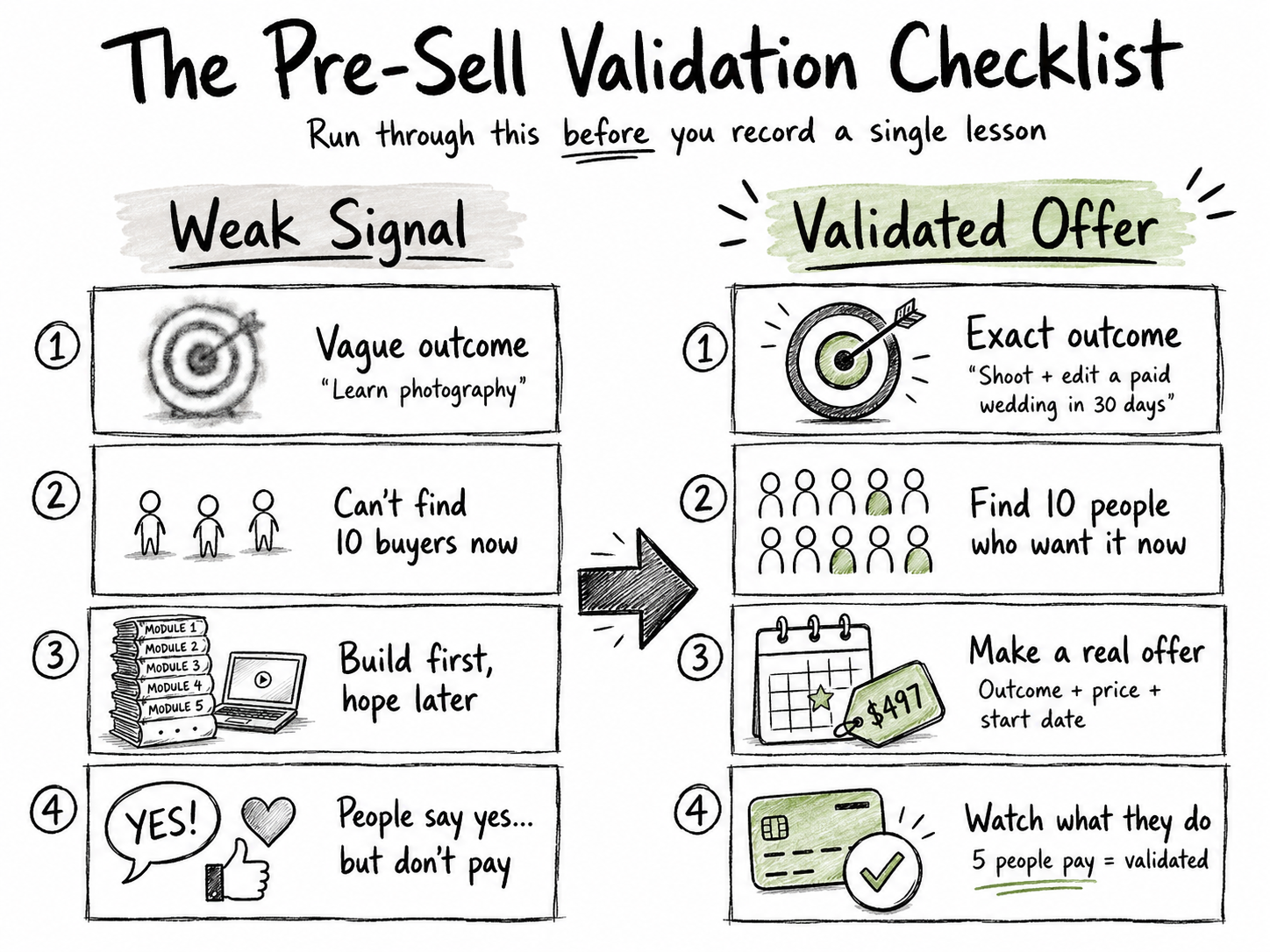
Pre-sell validation checklist infographic showing four steps to validate an online course idea before building it, including defining an exact outcome, finding 10 buyers, making a real offer with a price and start date, and confirming payment
Your founding cohort does three jobs for you at once.
It proves demand, it funds the build, and it gives you a small group of real students whose questions tell you exactly what the course needs to cover.
Suddenly you're not guessing at a curriculum in a vacuum. You're creating lessons around the answers to the questions you've actually been asked.
If the pre-sell flops, you just saved yourself two months and learned something for the price of a few conversations. That's a win, not a failure.
For a walkthrough of pressure-testing an idea before you commit, watch Validate Your Idea.
Step 2: Price against the outcome, not the hour
Price your online course against the outcome it delivers, not by the hours of content inside your online course.
Most experts price their first course wrong, but not you.
They'll either undercharge by 60 to 80% out of fear, or they overprice with no evidence to back it up.
Both come from the same mistake: pricing against effort or against a number they saw a competitor use, instead of pricing against the result the course delivers.
Here's the reframe. A student doesn't buy your 8 hours of video. They buy the outcome on the other side of it.
If your course reliably helps someone land freelance clients, you anchor the price to what landing those clients is worth to them, not to what the course cost you to make.
That's value-based pricing, and it's the single biggest lever on what you can charge.
The pricing math that keeps you out of trouble
You need two numbers before you set a price:
1. Your floor. Add up what it costs to create and run the course: factor in your time, tools, platform, and the marketing to sell it. Divide by the number of students you can realistically reach. That's the minimum you can charge without losing money. If your costs run $5,000 and you expect 100 students, your floor is $50 per student. Never price below the floor.
2. Your ceiling. What's the outcome worth to the student over the next year? If your course helps a coach add one $2,000 client, a $500 course is an easy yes for them. The ceiling is set by their return, not your effort.
Your price lives between those two numbers, pushed toward the ceiling as your proof gets stronger.
As a rough starting band: a focused mini-course tends to land between $50 and $200, a more complete course between $200 and $500, and a flagship program with coaching or community attached can run well into four figures. But those are starting points to react to, not answers. We break the full framework down, with the math and the calculators, in our guide to pricing an online course.
Use payment plans to widen the door
A $600 course is an easy yes for some people and a hard no for others, often at the same income level. A three-month plan at $200 changes the math for the second group without lowering your price.
Remember that a payment plan is not a discount. It's actually the opposite. Price the plan to total slightly more than the one-time price, not less.
Step 3: Build the smallest course that overdelivers the result
Especially for your first online course, you need to build a lightweight version that still delivers the result.
Overdeliver with personal emails to your founding members disguised as asking for feedback.
Once you've validated and priced, build the version that gets your founding students to the result, without the shiny extras.
Not the comprehensive 40-module monster, the shortest path to the result you promised.
This is where the AI shift works in your favor. Use it to draft your outline, tighten your scripts, and generate the worksheets.
What it can't do is bring the advice, the stories, and the "here's the mistake everyone makes" that come from having actually done the work.
That's your half of the deal, and it's the half worth paying for.
How to build a lean course structure that works
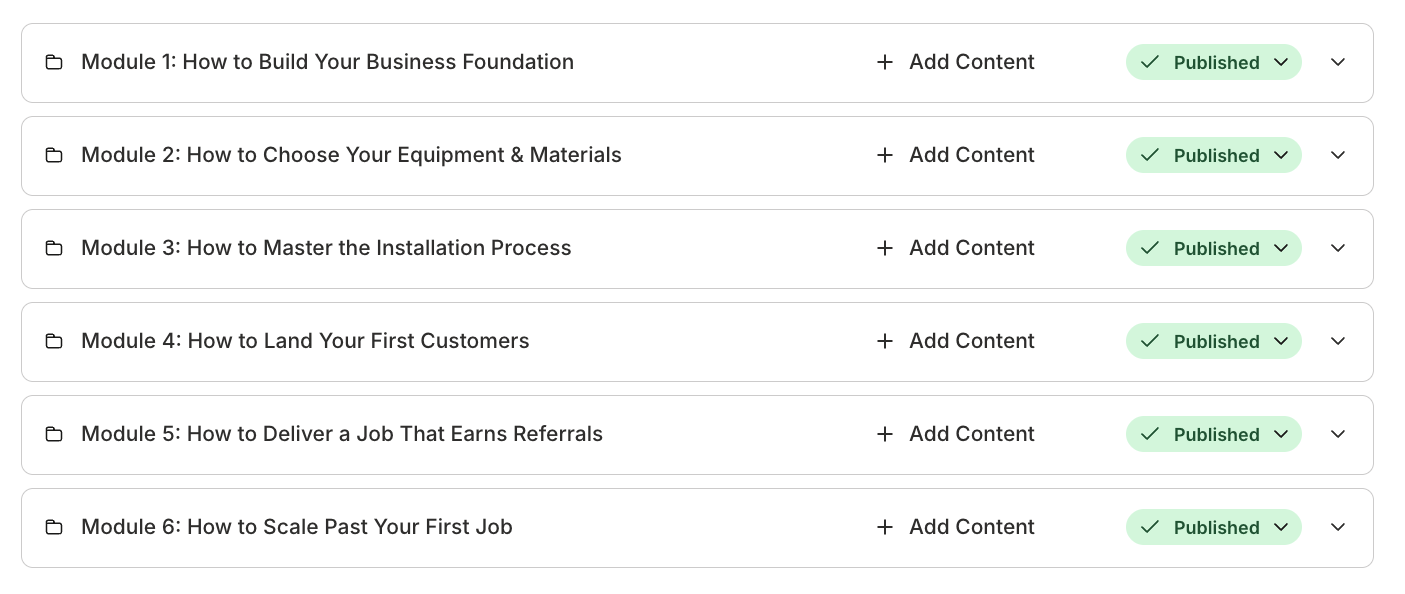
- One promise per course. A student should be able to say, in one sentence, what they'll be able to do when they finish.
- Modules as milestones. Each module moves the student one concrete step toward the outcome. If a lesson inside doesn't move them forward, cut it. The length of your course is not tied to the value.
- Action at the end of every module. A worksheet, a checklist, a quiz, a thing they do. Real learning happens when students do, not when they watch.
- Production good enough to not distract. Clear audio matters. A green screen does not. Your phone and a quiet room beat a studio that takes you three months to set up and use. If reading to camera trips you up, a free app like Teleprompter Lite turns a tablet into a teleprompter. I also recommend using canva to create slides using their “present and record” feature to turn it into a lesson-worthy video to upload to your course.
You can always add the advanced track later, and charge more for it. Ship the version that gets the result first.
If you're wondering how easy it is in 2026 to create your course outline, just copy this prompt below, paste it into your AI chatbot of choice, and then fill in the brackets. Then press enter.
You are an Online Course Architect who specializes in designing profitable, outcome-driven courses. Your task is to create a complete course outline using a milestone-based blueprint. The goal is to help me break down my course into clearly defined phases (modules), each representing a critical milestone that moves my student closer to the core transformation. Within each module, include 3–5 practical, high-leverage lessons that help my student overcome a specific barrier, build a real asset, or take meaningful action. Avoid theory or fluff, this outline should be lean, focused, and momentum-building. Structure the course so that every module unlocks the next, with a sense of progress and accomplishment baked in. Here’s the input you need from me to get started: The specific transformation my course delivers: [COURSE PROMISE]. My ideal student, and what pain points or desires are driving them to take this course: [TARGET AUDIENCE]. What the student needs to understand, build, or do at each major phase to get to the outcome: [MILESTONES]. The required tools, templates, or assets they’ll need to complete along the way: [COURSE RESOURCES]. Now that you have this information, generate a detailed outline with 5–7 modules. Title each module with a benefit-driven name. Under each module, list the specific lesson titles, each one tightly scoped to deliver a win. These lessons will eventually become videos inside my course. At the end, include a quick summary of the full transformation path to make sure the structure flows logically and delivers on the promise.Don't skip this prompt, go use it right now so you can have at least an outline to start with even if you have to make changes later.
Step 4: Choose where your course lives
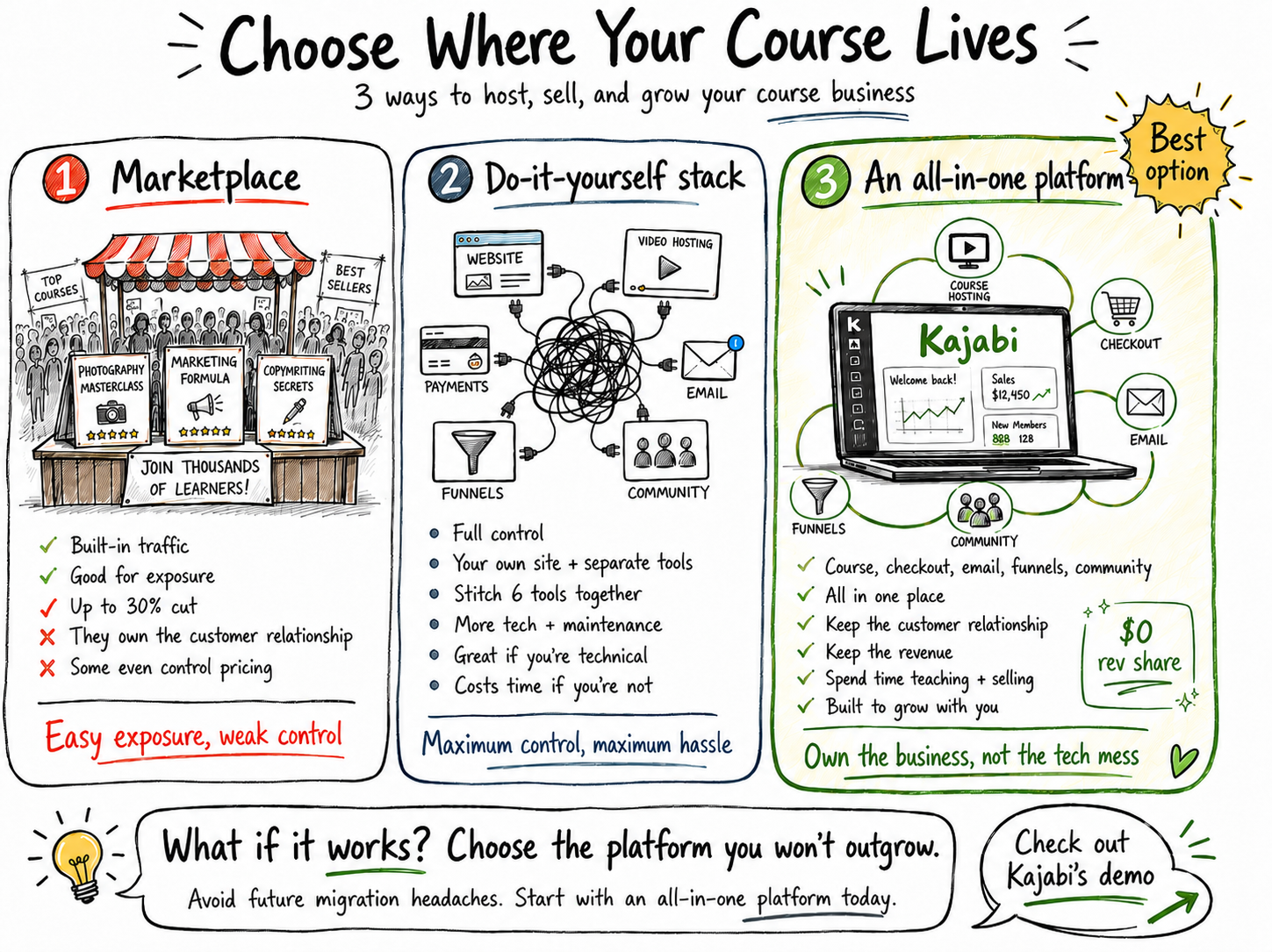
Here's the three options for hosting and selling: marketplace, do-it-yourself tool stack, or all-in-one platform. All-in-one is the best choice if you want to keep the customer relationship and the revenue.
Your course needs a home that hosts the content, handles payment processing, and helps you market and sell it. Again, you've got three real options, and the right one depends on what you're optimizing for.
I've outlined these options below, and the Kajabi team has put together this cost-comparison tool so you can see what it would cost to stitch it together with separate tools compared to what it would cost to just run it all in one place.
It's also free, takes 30 seconds, and doesn't require you to submit your email address to access the results (you're welcome).
The platform decision, in plain terms
Option 1: A marketplace (the big course bazaars) brings its own traffic, which sounds great until you read the terms.
Udemy takes 63% of organic sales (you keep 37%), and as of January 2026 they keep 85% of subscription revenue (you get 15%). Skillshare pays teachers approximately 20% of their subscription revenue (they keep 80%). You don't own the customer relationship, you can't email them, and some platforms even set the price for you.
You're renting shelf space in someone else's store, which means you're also subject to their algorithm, their content policies, and their payment schedule. You're betting on their judgment and their systems to deliver.
Good for exposure if you're starting from zero. Bad for building a business you control.
Option 2: A do-it-yourself stack (your own site plus separate tools for hosting, payments, and email) gives you total control over everything.
You might run WordPress for pages ($0-$300/month), Teachable for course hosting ($39-$249/month depending on plan), Stripe for payments (2.9% + $0.30 per transaction), Kit (formerly ConvertKit) or ActiveCampaign for email ($25-$145/month depending on subscriber count), and Zapier to glue it all together ($19-$99/month). That's roughly $150-$800 in monthly recurring costs before you sell a single course.
Then there's the integration time. A basic setup takes 20-40 hours of your time (or a contractor's time at $50-$150/hour). For a more complex funnel with conditional workflows, abandoned cart recovery, and member access gates, you're looking at 60-100+ hours. If you're technical and enjoy maintenance, this is a tax you're willing to pay.
If you're not, it's a part-time job stitching six tools together that were never designed to talk to each other.
Option 3: An all-in-one platform hosts the course, runs checkout, sends the emails, builds the funnels, and houses the connected community in one place.
You keep the customer relationship and the revenue (no marketplace middleman). You spend your time teaching and selling, not integrating software or troubleshooting why Zapier didn't fire at 2 AM.
Now it's decision time.
If your goal is a business you own, with customers you can contact again, the marketplace model fights you and the DIY stack slows you down.
Kajabi is the all-in-one option, and it doesn't take a cut ($0 revenue share) of your course sales. Plans run $143-$399/month (annual billing) with no transaction fees if you use Kajabi Payments. Note: if you connect your own Stripe or PayPal account instead, Kajabi charges a platform surcharge of 1-5% depending on your plan, in addition to your processor's standard fees.
The trade-off is real, so weigh it honestly against where you want to be in a year. And while we're at it, let's do the math.
Scenario: You sell $10,000 in course revenue in your first month.
- Marketplace (Udemy at 63% cut on organic sales): You keep $3,700. You own no customer data. You can't email them again.
- DIY stack ($300/month in tools + 2.9% payment processing): You keep $8,400 (after fees). You own the customer list. But you've spent 60+ hours gluing tools together and you're now on the hook for platform updates, bug fixes, and Zapier's brittleness when one tool breaks.
- All-in-one platform (Kajabi Growth at $199/month annual): You keep $9,801 (after your monthly platform fee). You own the customer list. You spent maybe 10 hours getting your course set up.
Sure, this scenario doesn't factor in whatever it costs you in marketing, and one month doesn't tell the entire story. But zoom out to year one.
On $100,000 in sales, a 63% marketplace cut costs you $63,000. A DIY stack with moderate tooling costs and the time tax of maintenance and troubleshooting might cost you $5,000-$10,000 plus 200+ hours of your time.
Kajabi costs you maybe $2,400-$3,000 for the year and zero integration induced headaches. Plus, you get to keep $97k since Kajabi doesn't take any of your revenue.
What if it works?
But before you decide on anything, have a "what if it works" mentality.
Here's what I mean: think deeply about what success looks like for your course business and how it will pan out a year from now when (not if) it works.
Are you ok with lighting 63% of your sales on fire to a marketplace cut, essentially becoming an IT specialist to manage all your tech stack integrations, or settling for a sub par platform that you'll grow and scale out of?
After almost 5 years of delivering webinars, one of the most common questions I answer is "how do I migrate to Kajabi, because the platform I'm on now can't handle the volume I'm doing?"
It happens when someone's course takes off on Teachable or Thinkific and they hit the platform's limits like payment processing delays, email delivery issues, API rate limits, or just the frustration of rebuilding funnels on a system that wasn't designed to scale. Then they face hours of migration work (exporting student data, rebuilding pages, redirecting links, re-enrolling people manually).
To be clear, this is doable (so don't geek out on me if I just described your current situation) but I think we can all agree that it would be better if you never had to migrate to another platform in the first place.
You can avoid a pain in the butt migration situation by choosing an all-in-one platform today that'll grow with you as you scale so you don't have to switch platforms tomorrow.
I encourage you to check out Kajabi's demo to see how experts set up and launch their business in less time than you'd expect.
Meet two millionaires on Kajabi
The platform you choose is the infrastructure your entire business runs on. Before you decide, it's worth looking at what the people who've already built at scale actually chose, and what happened when they did.

Ryan Peebles is a physical therapist who started filming course videos in a San Diego garage in 2017 with three students and a decision he'd already made: he would never quit, no matter what. His niche was chronic lower back pain, and his edge was personal.
Back pain had taken surfing from him for two years in his twenties, so he became obsessive about fixing it himself, eventually learning more than the physical therapists treating him. He packaged that knowledge into Core Balance Training, built a free trial funnel that replaced his phone-heavy sales process, and crossed $1 million in revenue in August 2023. By November 2025, he'd crossed $10 million, with 50,000 students in countries across every continent.
He keeps a folder of testimonials from students who canceled their scheduled back surgeries after finishing his course. That's the outcome he priced his course against, and it's the reason the math worked.
Carolina Jarinova is a pharmacist from Toronto who teaches lymphatic drainage self-massage online, and she's never spent a dollar on paid ads. She started with 10 students in May 2021 and crossed $1 million in revenue through consistent organic Instagram content and one principle she held without exception: every time she finished studying something new, she built a new class and published it.
Her students never ran out of reasons to come back.
She now has over 10,000 testimonials, more than 20,000 contacts on her email list, and 116 products on Kajabi. She's even co-authored a bestselling book. All of it built one class at a time, without a single paid campaign.
Here's what connects them, and why it matters to you: neither of them started with an audience, a big budget, or a polished product.
- Ryan had a garage and a personal track record with his own back pain.
- Carolina had a pharmacist's understanding of the body and ten people willing to show up.
What they both had was a specific outcome they knew they could deliver, a platform that didn't fight them as they scaled, and the willingness to keep going before the results were obvious. That's the actual starting position.
Forget the fancy studio, the massive following online, and the perfect launch-ready funnel.
Start with an outcome you've already helped someone achieve, and a place to teach it from.
Step 5: Launch with a sequence, not a single email
A course launch is a four-step email sequence: warm-up, open day, mid-launch, last call. Sending one announcement email is not a launch, not even close.
Here's the step that separates a course that *earns* from a course that *exists*.
A launch is a sequence that warms people up, handles their hesitation, and gives them a reason to act now.
Ideally, you've already got an active email list or newsletter full of warm contacts who actually open your emails. If you aren't aware already, an email list is your most important asset in your business and this is the best way, even in 2026, to stay in contact with your audience.
All of your efforts on social media, YouTube, and anywhere you write online should be focused on gaining subscribers to your email list, so you can send a sequence similar to the one I'm about to show you.
Even if you don't have what you'd consider a "big list" or even if you're starting from scratch, keep reading, because I'll cover that too.
A launch sequence you can run this month
1. Warm-up (3 to 5 days before you open). Send 1 to 2 emails that teach one genuinely useful thing tied to your course outcome. No pitch yet. You're proving you can help before you ask for money. End the last one by hinting something is coming.
2. Open day: give them a reason to move now. Announce enrollment with a real deadline or a founding price that goes away. Say exactly what it is, who it's for, what changes for them, and when the door closes. Urgency without a reason reads as a gimmick. Urgency with a reason converts.
3. Mid-launch: name the objections, don't dodge them. Pick the one to three hesitations that stop most people. Usually time, money, or "will this work for someone like me." Put it in the subject line and answer it head on.
4. Last call (final 24 hours). Send three emails on the closing day. One in the morning, one a few hours before the deadline, and another with just an hour left. Remind them what they lose when it closes. A large share of sales lands in those final hours, every single time.
The whole sequence can run on automation so it sends itself while you sleep.
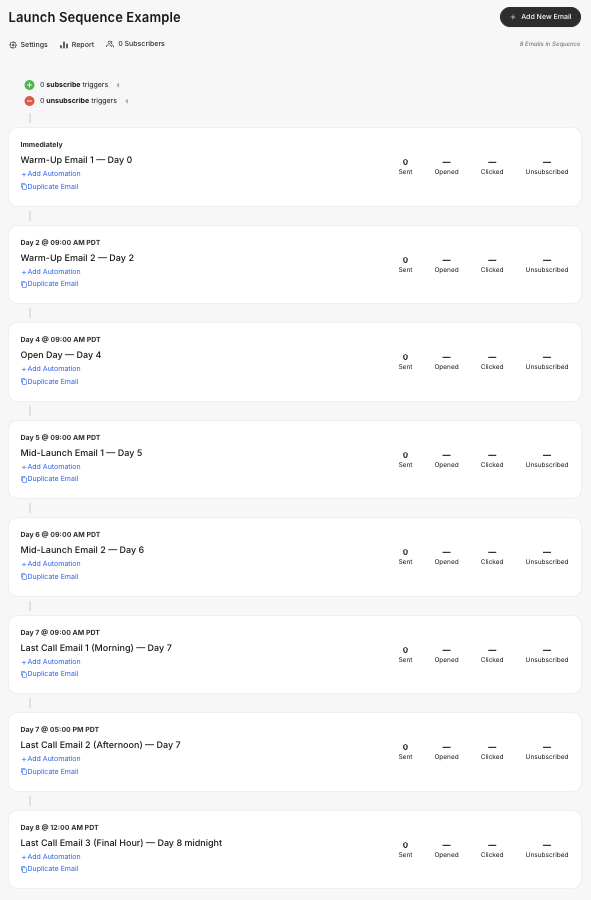
Build it once, and every future launch can start from this working template instead of a blank page. Add in testimonials from the previous launches as you go.
If you only have a small list, that's fine. A warm list of 200 beats a cold audience of 20,000.
Launch to the people who already trust you first.
Four ways to market the launch
The sequence is what you send. Marketing is how you get people into it.
- Search-driven content. Write the posts and record the long-form videos that answer the exact questions your target customers are typing into Google or YouTube. It's slower to start, but it compounds and positions you as the subject matter expert. One piece of content that ranks brings you strangers every week with no ad spend. Use AnswerSocrates to discover the questions people are asking on Google about almost any topic, for free.
- Short-form social with a strong hook. Meet people where their attention already is. There are over five billion people on social platforms (Statista), so start posting educational and entertaining videos that’ll put you in front of the right ones fast. Social media algorithms are designed to match your content to the people who will resonate with it most. Remember that the goal is to get people off social media and on to your email list, so point them to an extremely relevant free resource in the link in your bio. People hate watching ads, so instead of promoting your course offer straight to the sale, lead with value-based videos that earn you the right to acquire a follower + link in bio click, then let your email sequence do the selling.
- Partner and affiliate promotions. Borrow trust from someone who already has your audience’s attention. A podcast interview, a free webinar event, a sponsored email, joint social posts, or an affiliate split gets you in front of a warm crowd you didn't have to build. This is the fastest reach you can get, and it positions you as a trusted friend to the person they already know, like, and trust.
- Paid advertising. Ads can amplify everything else you're already doing, but they can't save a weak offer. Before you spend a dollar, make sure your landing page converts, your email sequence sells, and you've validated demand organically. Once those are functioning well, ads just pour more people into what's already working. Start with Meta ads if you're targeting a broad consumer audience, or Google Search ads if your buyers are typing a specific problem into Google.
If you're wondering what kind of free resource you should promote to your audience to gain email subscribers from social media, then you'll find my 7 Prompts to Profit: Build Your eBook, Landing Page & Follow-Up Sequence video guide incredibly helpful.
As you watch, you'll learn how to craft a high-converting eBook, create the copy for the landing page, and build the automated email sequence that sells your offer.
Step 6: Turn student wins into your next launch
Capture wins and progress as testimonials and use them as proof to fuel your next launch.
The first sale is the hard one.
After that, your students become the sales engine, if you set it up intentionally.
Get your first cohort of customers to the finish line, then capture the results they achieve. Repeat.
A short result, in their words, with a number attached, is worth more than any ad you could write. "I booked three clients in my first month" sells the next launch better than anything you'll say about yourself or your course.
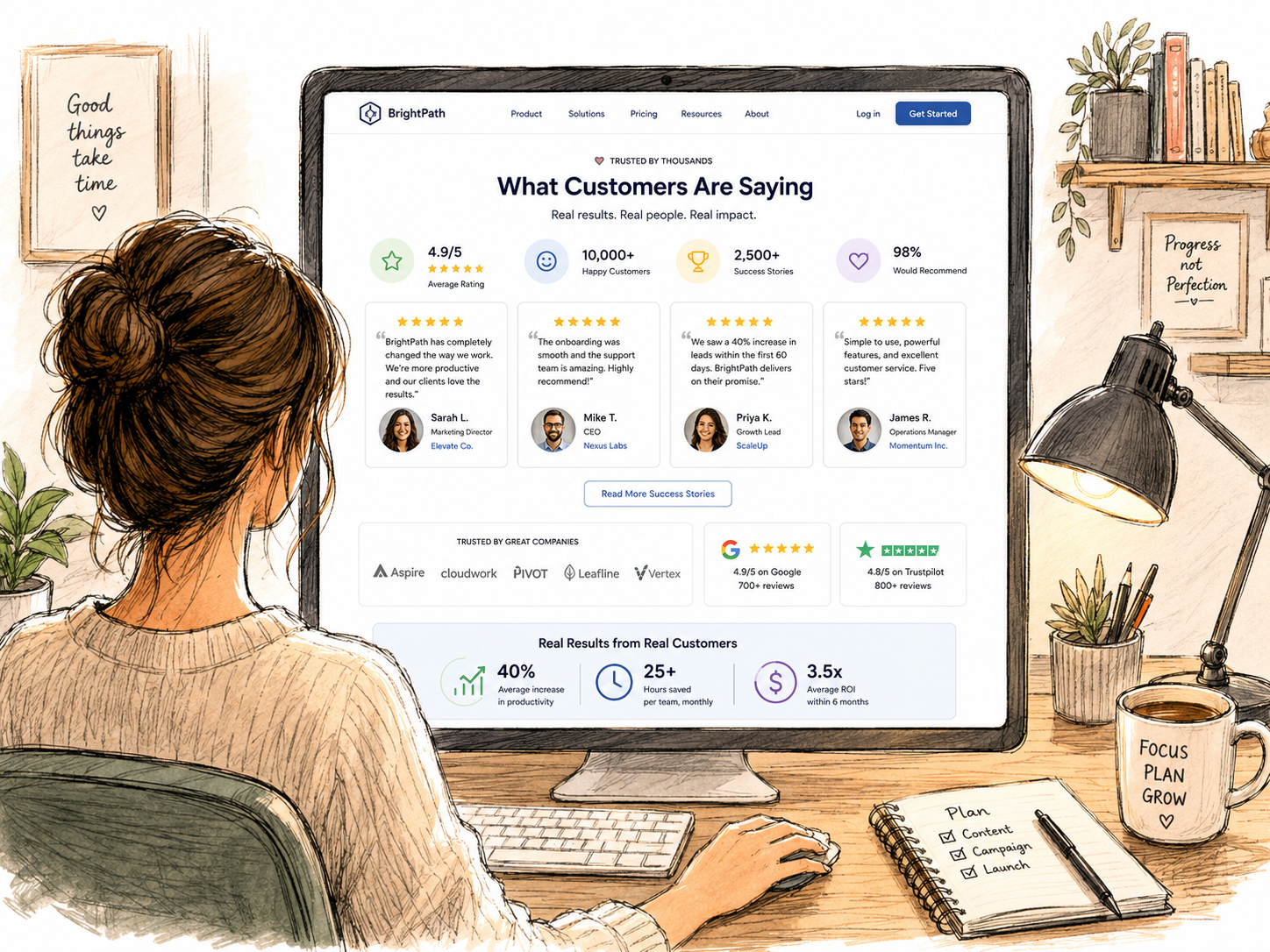
It's the same reason you check the reviews on Amazon before you have that Roomba shipped to your house and why you check what other people said about the steak at the restaurant you have planned for date night.
Two things make this flywheel turn:
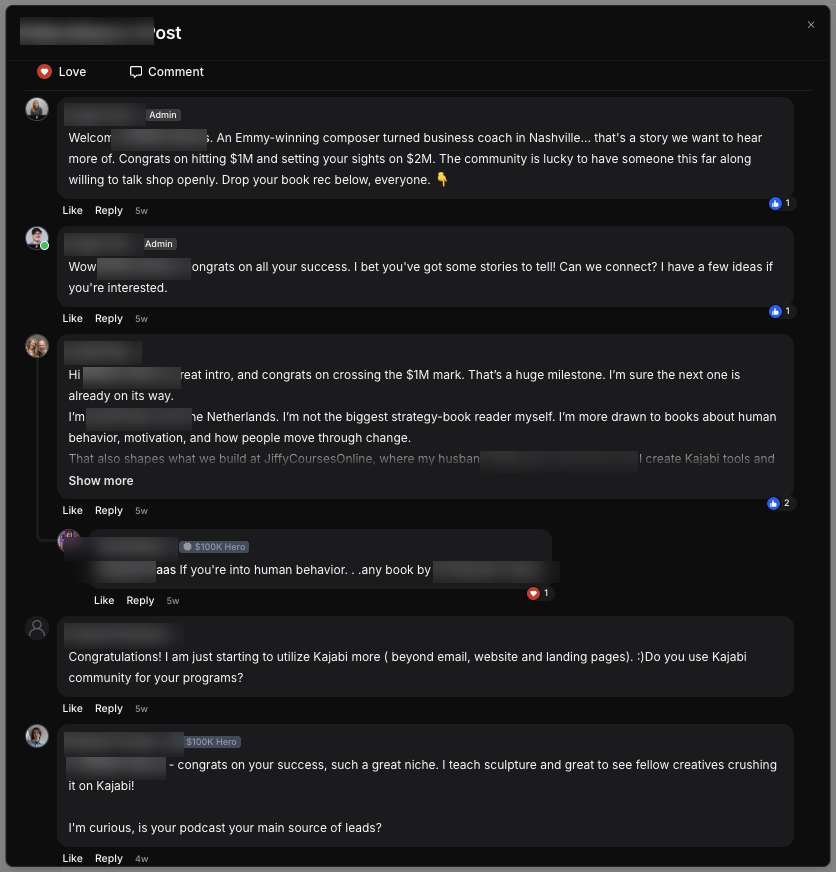
1. A community where students see each other win.
Wins are contagious, and a member who's getting results sticks around and tells people. A community attached to the course raises completion and gives you a steady stream of proof.
2. A simple ask for proof, built into the course.
At the milestone where students hit the result, ask them what changed. Don't wait until the end and hope. Catch the win when it happens.
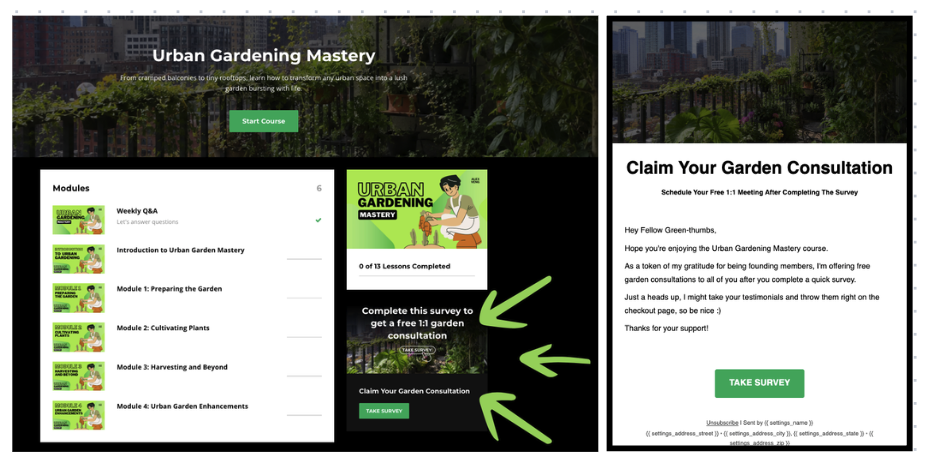
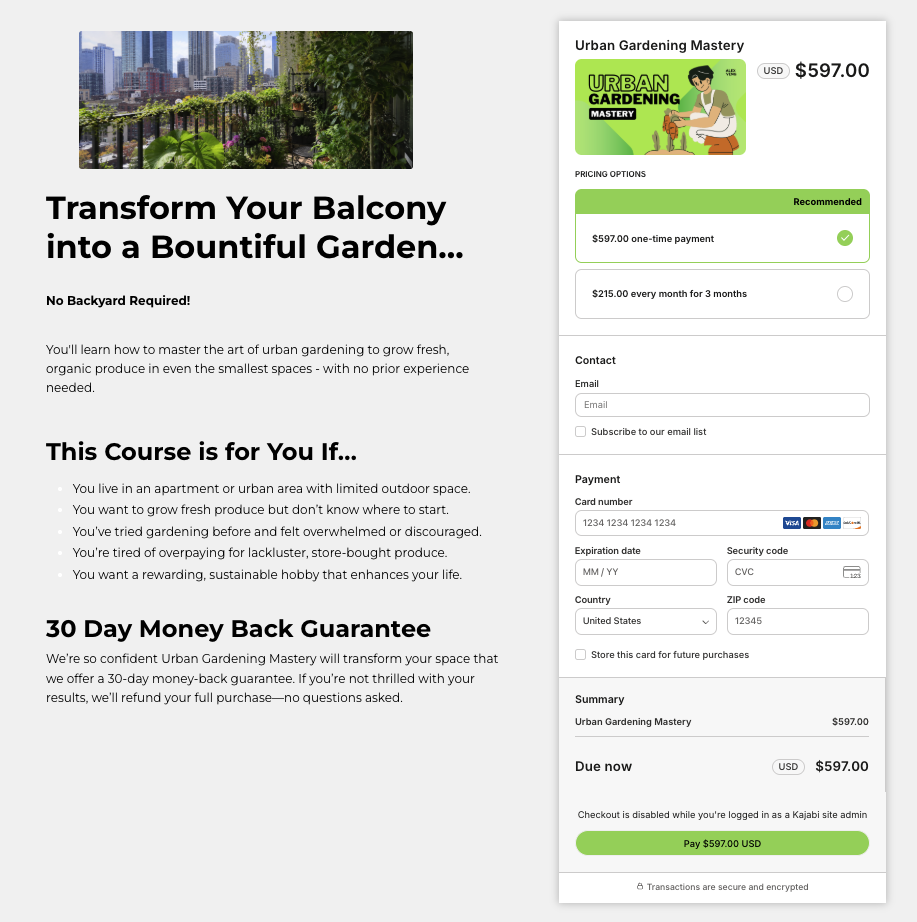
As you collect these proof pieces and testimonials, put them on display on your sales page and checkout pages.
I've personally seen checkout pages that have one sales video at the top and a wall of testimonials underneath it, and a buy button at the bottom. Simple.
Step 7: Borrow while you build an audience you own
When you don't have an audience, borrow one (while you build your own). Use podcasts, webinars, social media, and partnerships with people who already have the reach you need.
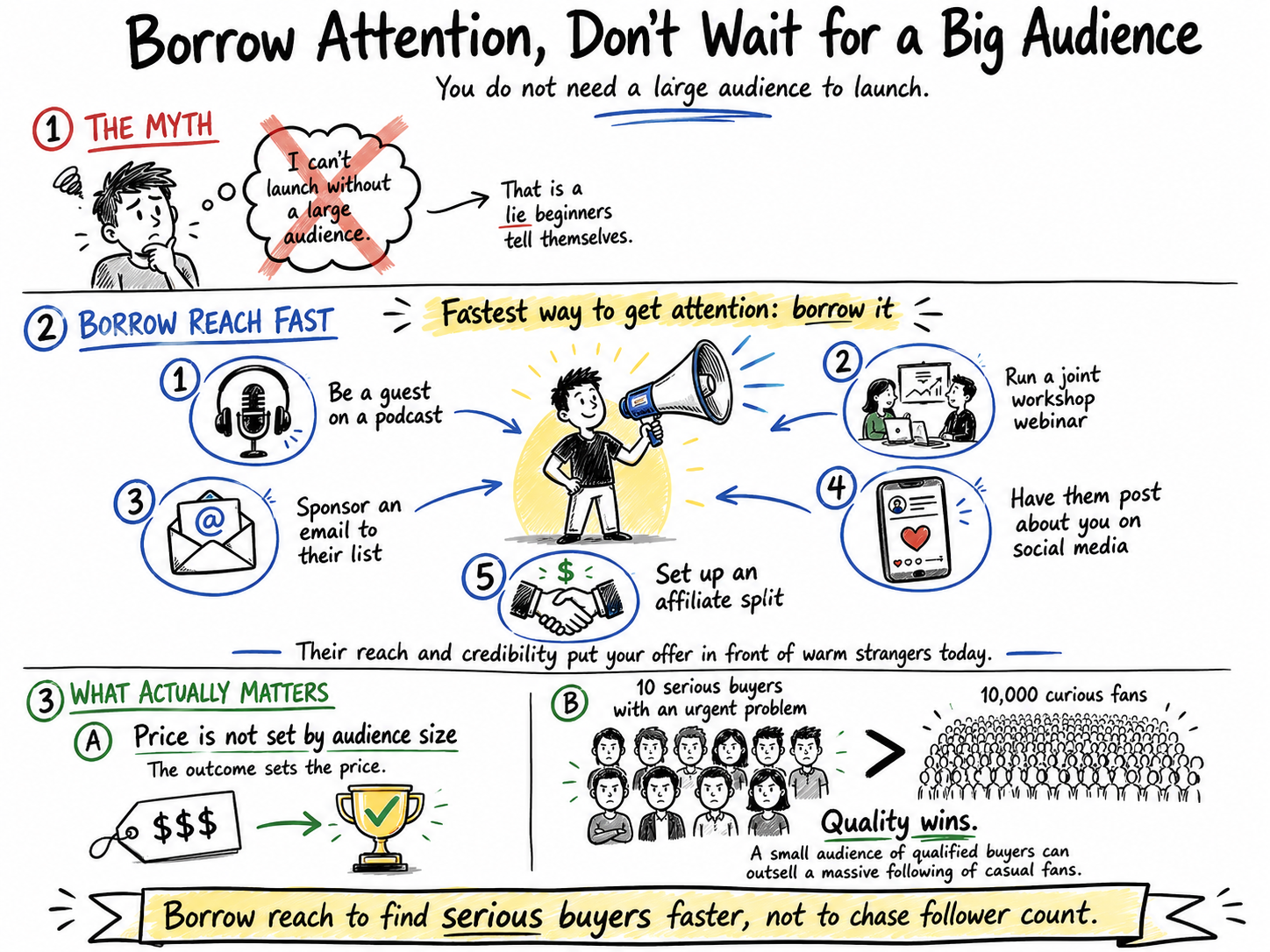
This is for you if you're thinking to yourself, "I can't launch without a large audience" and other lies like that.
When you're starting out, the fastest way to get attention is to borrow it from people who already have it.
Go be a guest on a podcast, run a joint workshop webinar, sponsor an email to their list, have them post about you on social media, or set up an affiliate split.
Wondering how to do that? I got you.
How to guest appear on a podcast
Find 10 shows your ideal student already listens to. Search "[your topic] podcast" on Spotify, Apple, and YouTube then sort by recent episodes so you know the show is active.
Pitch the host one specific episode idea that helps their audience, not a pitch about you. In the episode, teach something useful and mention your free resource naturally, near the end. Ask the host to include the link in the show notes.
Not every host will say yes, but on the shows where you do land a spot, ask if you can feature their podcast on your site. Most will happily agree. Add an "As Heard On" section with each show's logo, and you turn a single guest appearance into lasting social proof that builds your credibility with every visitor to your site.
How to run a joint workshop webinar
Partner with someone who serves your same audience but isn't a direct competitor. The whole point is to build hype around teaching their audience something new and genuinely useful, something they'd be excited to show up for live.
Think of it as a fair trade: they have the email list, you have the expertise. You can even make it worth everyone's time by charging a fee for the webinar and splitting the profits.
You teach, they bring the crowd, you both promote it to your lists. Agree up front on who emails what and how many times. Run it live so people show up, record it, and point everyone to your free resource at the close.
One good co-hosted webinar can outperform a month of solo posting on social media.
How to sponsor an email to their list
Find experts with engaged newsletters in your space and ask their rate to run a dedicated send or a classified spot. Newsletter directories and a quick "do you accept sponsorships" email will surface pricing fast.
Don't sell your course in the email. Sell the click to your free resource, then let your sequence do the work. Track it with a dedicated link so you know the list was worth it.
How to get them to post about you on social media
Offer a trade, not a favor. Create something genuinely useful for their audience (a guest carousel, a clip, a free template) so the post makes them look good for sharing it.
Reciprocate by featuring them too. The warm intro from someone their followers already trust converts far better than a cold ad ever will.
How to set up an affiliate split
Give partners a unique link and a commission on every sale they send. Most course platforms handle the tracking and payouts for you, so you set the percentage once and partners get paid automatically.
This is the lowest-effort option for you because the partner is motivated to promote, and you only pay when a sale actually closes. Hand them swipe copy and a few ready-to-post assets so saying yes is effortless.
Kajabi has a built-in affiliate program that tracks referrals and handles payouts for you, so you can spin this up without bolting on another tool.
Borrow reach to find buyers, not followers
You'll be tempted to chase whoever has the biggest audience. That can get expensive.
Podcasts, partner webinars, email sponsorships, affiliate promotions, and social posts all work because they let you skip the cold-start problem.
Their reach and credibility get your offer seen by warm strangers today, while your own following is still small and growing.
When it comes to pricing, please understand that your audience size now doesn't set your price. The outcome does.
What size changes is how easily you get enough of the right people to see the offer at all.
A larger warm audience means more qualified buyers land on your sales page with less effort on every launch.
But size and quality are not the same thing, and quality wins every time.
A small audience of serious buyers with a painful, expensive problem will outsell a massive following of casual fans every time. Ten people who urgently need the outcome beat ten thousand who are mildly curious.
So borrow reach to find those serious buyers faster, not to chase a follower count.
The catch with borrowed reach is right there in the word: it's borrowed.
You don't control it.
A podcast moves on to another episode, algorithms shift, social posts are only popular for a few days, a webinar eventually ends, and an email eventually fades off into the inbox abyss.
That's why every bit of borrowed attention should feed something you keep.
An owned audience is yours.
An email list and a community you host are direct lines to people that don't sit on anyone else's platform.
Every launch in the future... you reach them for free, every time.
Here's the takeaway: borrow attention now while you need it most, then convert it into ownership over time.
Here's exactly how to "rent to own"
- Point every borrowed moment at a free resource. A guest spot, a shared email, a clip. The ask is never "buy now," always "grab the free thing," which moves a stranger onto your list where you can build trust.
- Turn your best buyers into a community. A member who shows up every week is worth more than a thousand passive followers, and they're the ones who buy your next launch first.
- Treat the list as the real asset. Courses come and go. The audience you own is what lets you launch the next one without borrowing from scratch. If you’re building your business as an expert, your customers are buying access to you, rather than just the latest product you created. Remember that.
Truth be told, this is a long game that compounds based on the effort you put in. The course is the product, the owned audience is the business.
Where most course launches die
The mistakes that kill course launches aren't random, they tend to follow a pattern, and once you know it, you start seeing the warning signs early enough to actually do something about them.
None of these are about how good your content is or how much you know about your subject. They're all process failures, which means they're all preventable.
Here are the five worth knowing before you build.
1. They built before they validated. Two months of recording for an audience that was never there. The fix is to validate the demand in Step 1, every time. Pre-sell, then build.
2. They undercharged out of fear. Pricing at $47 because it felt "safe," or because "this is my first course" then needing 200 sales to make it worth the effort. The low price didn't make it easier to sell. It made the math impossible and signaled the course was thin. Anchor the price to the result instead.
3. They had no sequence. One "it's live!" email to a cold list, then crickets. A course without a launch sequence is a product nobody was prepared to buy. Build the four-step sequence.
4. They built too much. The 40-module course that took so long to finish that the founding students lost interest and the momentum died. Ship the lean version, add later.
5. They never captured proof. Students got results and the expert never asked, so the second launch started as cold as the first. Build the proof ask into the course.
Every one of these is a process problem, not a talent problem. Which is good news, because process is fixable.
Frequently asked questions
Listen, I deliver six webinars every week to hundreds of experts who are trying to turn what they know into income, and naturally over the past four years they have asked me questions about building their future online course. I took their most common questions and answered them below for your benefit.
How much does it cost to create an online course?
Less than you think. You don't need a studio anymore. A phone, a quiet room, clear audio, and a platform to host and sell on will get your first course live. Your real cost is the platform you choose and the sweat equity it takes to build the thing, not gear. Validate with a pre-sell first so the course funds itself. All in all, you're looking at a few hundred bucks a month.
What equipment do I need?
Start with what you have now. Your phone shoots better video than a $3,000 camera from five years ago. A quiet room and a $30 USB microphone will get you 90% of the way there, because clear audio is the only production value that actually makes people stop watching. Here's what I actually recommend to get started: your phone or laptop camera, a USB mic or wired earbuds with a built-in mic, a window for natural light, and a free app like Canva to record your screen with slides if you don't want to be on camera at all. The green screen, the ring light, the DSLR, the teleprompter rig, none of that is what's stopping you from selling. The only equipment that matters is whatever it takes to record something you're not embarrassed to send to a friend.
How long should an online course be?
As long as it takes to deliver the outcome, and no longer. A focused course that gets someone a result in a few hours of content beats a 40-hour course they never finish. What you charge follows the result your course delivers, not how long it is.
Can I sell my course on multiple platforms?
Technically yes. Practically, be careful. You can host your course on Kajabi and cross-post or promote the exact same course on a marketplace at the same time. The issue is that marketplaces own the student data from the students who buy through them. You can't email those people, you can't retarget them for your next launch, and you can't build a relationship that leads to a second sale. If the goal is a business you own, your primary platform should be one where you control the customer relationship.
How much should I charge for my online course?
Mini courses usually land in the $47 to $147 range, while signature courses tend to sit between $197 and $997 depending on the depth, outcome, and audience. If you're selling a premium cohort, coaching offer, certification, or high-touch program, you can usually price much higher, often from $1,000 to $5,000+, with certification-style programs commonly starting around $2,000 or more. We walk through the full math in our pricing guide.
Do I need an audience before I create a course?
You need a small group of people who want the outcome, not a big following. Ten people who'll pay beats ten thousand who'll see you post about it on social media. If you have no audience at all, rent someone else's while you build a free resource that delivers a quick win first, then nurture that list before you launch a paid course.
How long does it take to create a course?
It depends on how long you let it take you. The experts I've watched launch fastest share one thing in common: they built for a founding cohort, not for an imaginary future audience. That means they recorded the minimum content needed to get their first students to the result, then refined from there. If you do it that way, you can have a launchable course in two to four weeks, most of that time spent making sales... not building the course content. If you try to build the complete, polished, definitive version before you let a single person buy it, you'll spend three to six months on something that might not land the way you think it will. The validation-first approach in Step 1 of this guide isn't just about demand. It's also what forces you to scope the course small enough to actually finish it.
Do people still buy courses in 2026?
Every week I get on webinars with hundreds of people who are actively looking to create their own, and the Kajabi Heroes collectively have earned over 11 Billion dollars... so yes. What changed is the filter. The ones that sell are built around a specific outcome from someone with a real track record, not packaged information someone could get from a chatbot. AI made generic knowledge worthless. That's not bad news for experts, it's the best news they've gotten in years, because it means the people who've actually done the work now have a clear advantage over people who just organized information well. Courses aren't dying. Courses that don't deliver are dying. The bar went up, and that's a good thing.
Can AI create my online course for me?
AI can draft your outline, scripts, and worksheets, and you should let it. What it can't supply is the proven outcome and the judgment behind it, which is the part students actually pay for in 2026. Use AI to build faster. Bring the expertise yourself.
How do I get my first 10 students to buy my course?
Talk to people directly, and I mean a real conversation, not a post, not a story, not a broadcast email. Here's what I'd do: list out as many people in your life as you can who either have the problem your course solves or know someone who does. Send each one a personal message. Not a pitch, just a check-in that ends with "I'm putting together something on [outcome], is that something you or anyone you know is working through right now?" From these conversations, you'll surface 3 to 5 people who actually want it. Those are your founding students. Sell them the course before it's built at a founding price. Their yes is your validation, their tuition funds the build, and their questions tell you what to actually put in the modules. Your first 10 students almost never come from ads or a launch sequence. They come from real relationships and direct conversations. That's not a weakness in the strategy, that's THE strategy.
Do I need to be a teacher or have a certification to sell a course?
No. Not even close. The people I've watched sell the most on Kajabi aren't former teachers. They're a back pain specialist, a photographer, a bookkeeper, a wedding florist, a former nurse turned health coach. What they all have in common is that they've gotten a specific result for real people, and they can prove it. Nobody is paying you for your credentials. They're paying you because they believe you can get them where they want to go. A certification might help in a regulated industry, like licensed therapy or financial advising, but even then, the proof that your students win is more persuasive than the letters after your name. If you've helped even one person get a meaningful result, you have something to teach. The credential is the outcome, not the diploma.
What's the best platform to create and sell online courses?
The one that hosts, sells, and markets in one place so you keep the customer and the revenue. Marketplaces take a cut and own your students. A do-it-yourself tech stack means maintaining integrations between six tools. An all-in-one platform like Kajabi handles the course, checkout, email, funnels, and community together. Choose wisely.
Your next step, based on where you are
You've gotten people a real result but have no course yet:
- Announce and pre-sell a founding cohort to your list this month, then build it for them.
- Collect the student results as testimonials. You're closer than you think.
- Research platforms, and start with Kajabi.
You have expertise but no audience:
- Start with a free resource that delivers a quick win, and nurture that list before you start selling anything.
- The course comes after the trust.
- Learn how to create an eBook lead magnet to build your list with my 7 Prompts to Profit video guide.
You have a course that isn't selling:
- There are three reasons people aren't buying your offer, and fixing them now will drive more sales.
- First, the words on your checkout page may not clearly communicate how your course (solution) solves the buyer's problem, so focus on the end result more + what they'll be able to do after taking your course.
- Second, the price outweighs the perceived value, so build a healthy value stack (everything the customer gets when they sign up) so the price feels justified.
- Third, the right people don't know your offer exists, which you solve by getting it in front of them either through a renting someone else's audience, paid ads (effective but expensive) or an organic social media strategy that creates content attracting people with the problem you solve.
You're starting from zero:
- Pick the one problem that you know you can help someone solve based on what you already know.
- Start contacting people who may have this problem. Scroll back up to Step 1. Use Kajabi to build it.
Wherever you land, the platform still matters.
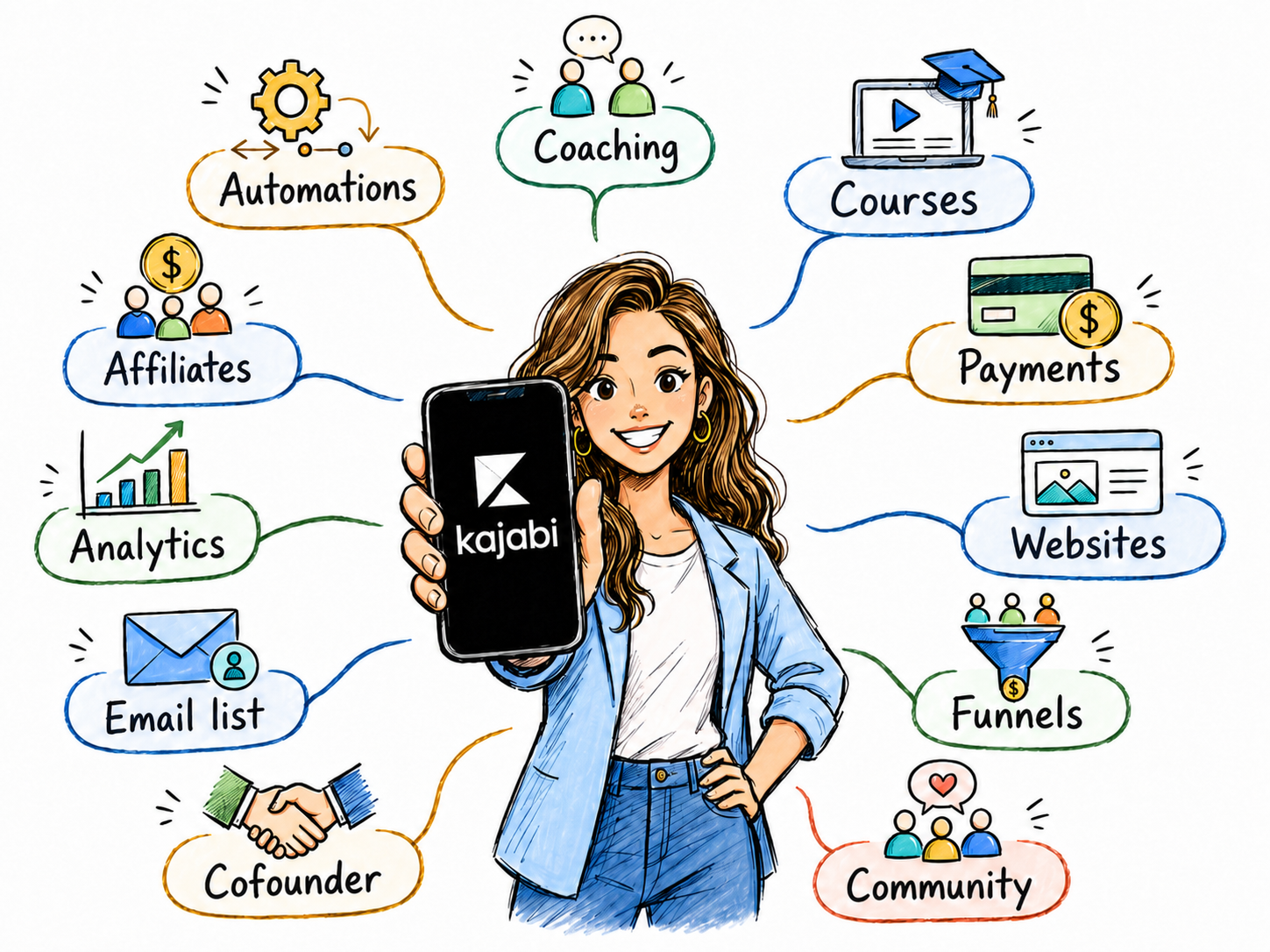
Kajabi lets experts like you sell courses and beyond that, run coaching, take payments, build a community, and automate the marketing that sells it, all in one place, with no technical setup and migration help if you're moving from somewhere else.
It's built for the first-time expert and the seasoned one, so you're running one platform instead of stitching together six.
You already have the expertise.
The guide you just read is how you turn it into a course people actually buy.
Watch the Kajabi demo and see exactly how you can implement everything + more inside this guide.
The best time to create a course was 2019, and the second best time is right now.
The Author

Alex Veng is a Senior Customer Engagement Specialist at Kajabi, where he helps Experts turn their knowledge into digital products, marketing strategies, and scalable online businesses. Before joining Kajabi, Alex generated over half a million dollars using the platform, giving him firsthand experience with the same challenges Experts face when packaging their knowledge, attracting an audience, and making consistent sales. Over the past four years, he has led hundreds of live webinar sessions, taught for more than 350 hours in live training environments, answered hundreds of real customer questions, created practical video guides, and spoken on stages about the future of digital business, AI-powered content, and the expert economy. His perspective is shaped by both real-world execution and thousands of conversations with Experts trying to turn what they know into income.