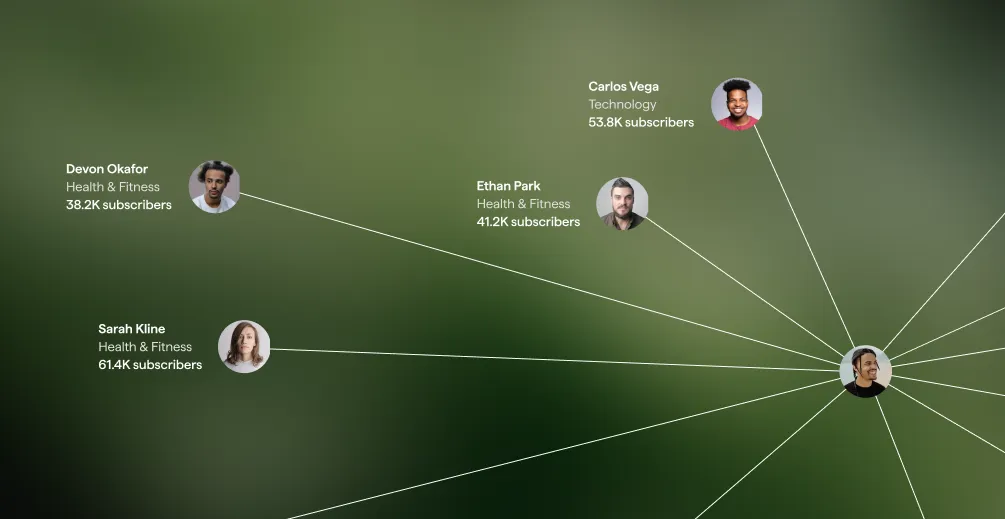

The most useful thing inside Amplify is also the simplest. It is a directory.
Every Kajabi expert who has opted in to publish appears in it. Each profile shows the size of their audience, the topics their subscribers care about, and the price they charge for a sponsored block. You browse. You read. You choose. There is no algorithm matching you to a publisher you've never heard of, and there is no mystery about what a placement costs.
Most experts who open Amplify for the first time are surprised by how much information sits openly in the directory. The reason is that the directory is the network's primary mechanism for maintaining trust. When both sides of a sponsorship can see exactly what they're getting before any money changes hands, the friction that has historically prevented peer-to-peer promotion between experts disappears.
What's on a publisher profile
Every publisher's profile in the Amplify directory contains: the publisher's name and brand; audience size in unique contacts; topic categories; and their pricing as a flat fee per sponsored placement.
There are no anonymous testimonials and no star ratings. The information you use to make a decision is the structural information about the audience, the editorial, and the price. The numbers are the review.
How to read a publisher's audience
Audience size is the number that draws the eye. It is not the number that should drive your decision. A publisher with 30,000 subscribers in your exact niche will outperform a publisher with 300,000 subscribers in an adjacent niche whose list has gone half-cold.
Things to actually look at: topic alignment (is this audience interested in something close to your offer?); pricing relative to the audience; and past placement performance where available.
What the directory deliberately doesn't show
There is no algorithmic match score. There are no real-time bidding mechanics — pricing is the publisher's listed flat fee. There is no targeting layer — you're sending your offer to their full list. There are no DMs outside the structured request flow Amplify provides.
These omissions are not gaps. They are how Amplify maintains the network's credibility. Every piece of friction that traditionally lives in ad network bidding wars, targeting fragmentation, and opaque review systems is friction Amplify deliberately removed.
The seller path: listing your own profile
Set your pricing based on engagement, not just size. Decide on placement frequency honestly — the number that protects your list is the number that produces returning advertisers. We offer recommended prices but you are free to set your own as you know your audience best.
The buyer path: choosing a placement
Start with topic alignment, not size. Shortlist three to five publishers. Submit the request — Amplify's request flow handles the copy collaboration with the publisher, payment, delivery, and verification. Track what comes back: opens and clicks land in your dashboard.
Why this design protects the network
The directory works the way it does because the network remains valuable only as long as both sides keep using it. Flat fees, no bidding, real engagement metrics, and no review system are what keep both sides at the table. It also keeps the cost of vetting a placement low enough that Heroes can actually run sponsorships without building an in-house ad operation.
A few practical patterns
Buyers who shortlist three publishers and run all three placements in the same month see clear performance differences and learn fast which audience converts on their offer. Publishers who book the same advertiser twice tend to see better second-placement engagement. Heroes who sit on both sides of the network — buying placements for their own offers while selling sponsored blocks in their broadcasts — are using Amplify as it's designed to be used.
If you don't know Amplify, you don't know Kajabi.
See Amplify in action → kajabi.com/amplify