
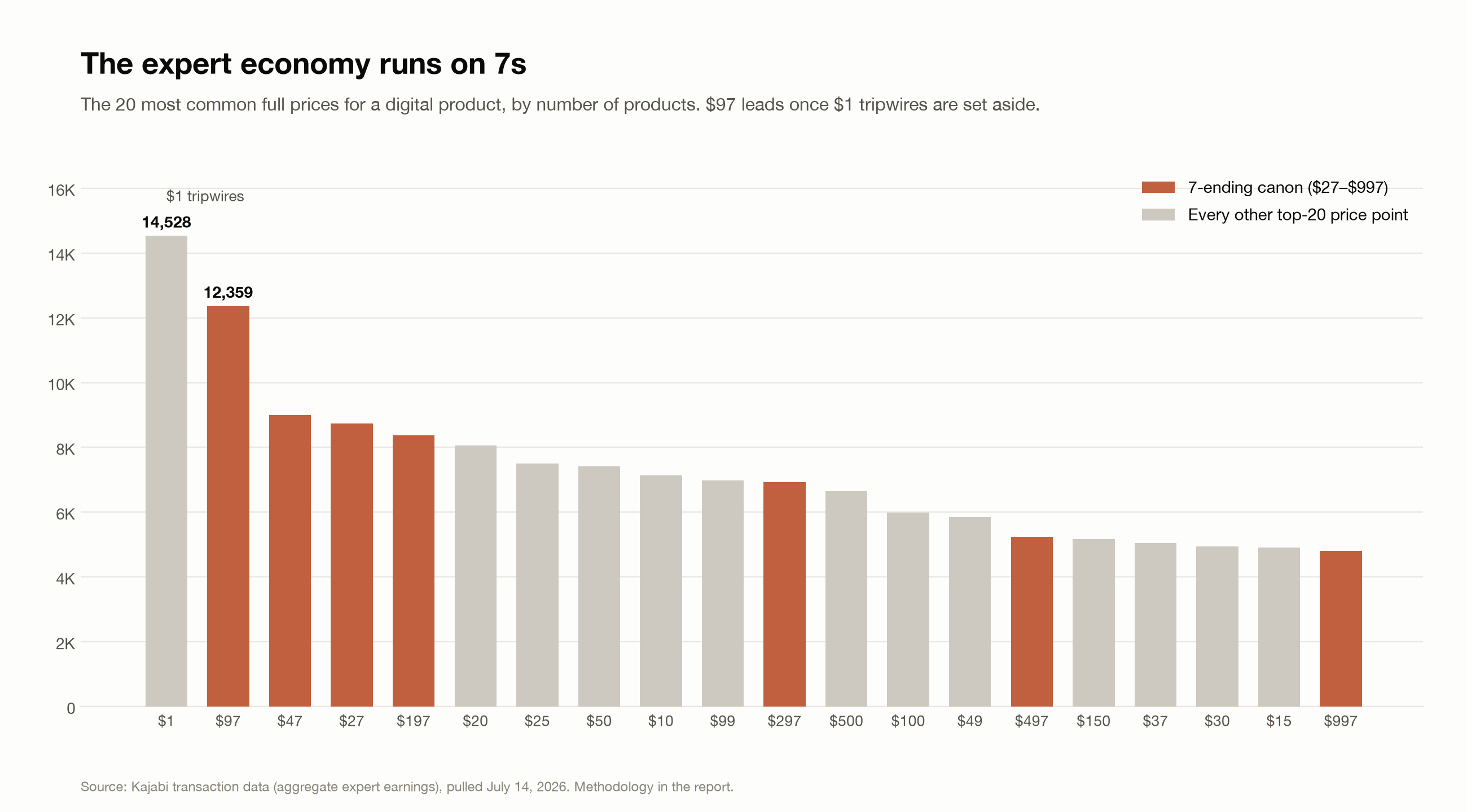
Set aside the dollar tripwires, and the most popular price for a digital product is $97.
You'd expect $99. Retail spent a century training everyone on .99 endings. The expert economy runs on 7s: $27, $47, $97, $197, $297, $497, $997. Across more than 600,000 digital products sold on Kajabi, that ladder shows up with almost mechanical regularity. Weight the data by what buyers actually purchase and the 7s are still all over the top of the list.
Why 7? Somewhere in the direct-response fossil record, someone decided $97 outsells $99, and three decades of copywriters repeated it until it hardened into physics. Almost nobody tests it anymore. It's just what you charge.
Which tells you the uncomfortable thing about pricing in this industry: most of it is inherited rather than decided.
So we decided to look at what actually happens. Experts on Kajabi have earned more than $11.7 billion across 101 million transactions since 2010. Every number in this report comes from those transactions... aggregated, anonymized, and audited (full methodology at the bottom). No survey answers. No guru math. Just what buyers paid and what experts earned.
One thing you should know about our motives: Kajabi earns money when you sell at any price. Cheap sells fine for us. So take this report as what it is... us telling a large share of our own customers they're leaving money on the table, because we'd rather you build a business that lasts than a product that pays for dinner.
Here's the one-sentence version of everything below: underpricing is the default failure mode of the expert economy. Cheap is where expert businesses go to die, and the data on that is unambiguous.
The default is too cheap. And it shows.
Split every one-time offer into price bands and compare two things: how much of the catalog sits in each band, and how much of the money does.
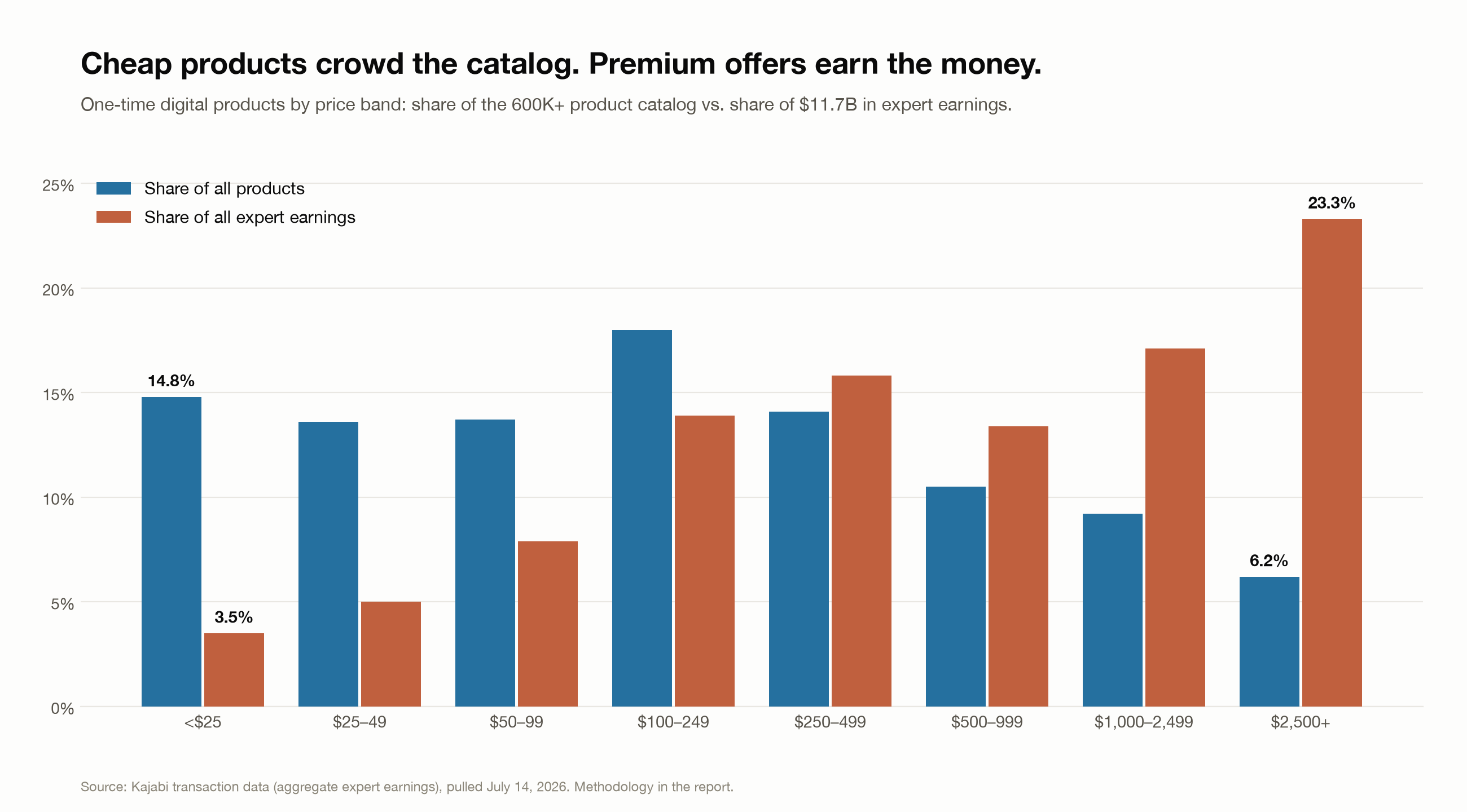
The top row is the whole argument. Products priced under $25 make up 14.8% of everything for sale on Kajabi and produce 3.5% of all expert earnings. The median under-$25 product earns $96 over its entire lifetime. Lifetime. Half of them earn less than one nice dinner, ever.
Now read the bottom two rows together. Offers priced at $1,000 or more are 15% of the catalog and generate 40% of all expert earnings on Kajabi.
And look at the median column on the way down. It climbs at every single step. There is no cliff where buyers stop showing up. The demand cliff that keeps experts pricing at $27 exists in their heads, and nowhere in 101 million transactions.
(If the offer you're pricing is a course, we've turned these numbers into a step-by-step guide on how much to charge for an online course.)
The price-ceiling staircase
That first table describes products. This one describes people, and it's the chart this whole report exists for.
Take every expert, find the most expensive one-time offer in their catalog... their price ceiling... and group them by it. That ceiling can come from any of the five business models for selling your expertise: a course, a coaching package, a community, a consulting engagement, a certification.
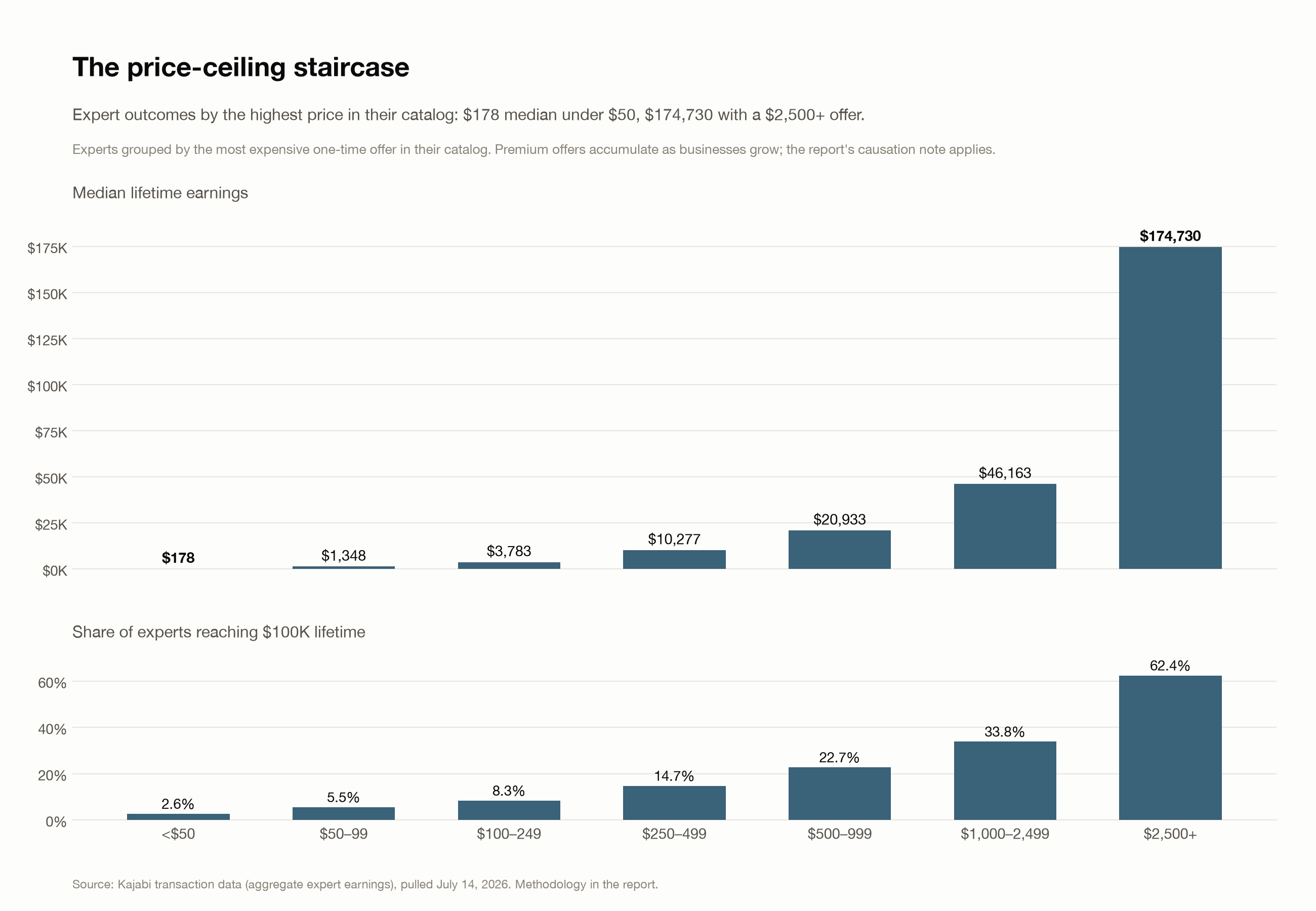
Experts whose catalog never crosses $50 have a median lifetime earnings of $178, and 2.6% of them ever reach $100K. Experts with at least one $2,500+ offer have a median of $174,730, and 62.4% of them cross $100K. That's roughly a thousandfold gap in the median outcome.
An honest word about causation. This chart deserves a caveat, so here it is in plain English: premium offers accumulate as businesses grow. Successful experts add high-ticket offers over time, the same way they add products. We are NOT claiming that changing a number on your checkout page multiplies your revenue by 1,000.
Here's what the data does say, without qualification: almost nobody builds a real business selling only cheap products. The under-$50 rung is functionally a dead end... a 2.6% survival rate to six figures. And when we ask our most successful customers for their single best piece of pricing advice, the top answer is the same idea approached from the other side: price the transformation. The people and the numbers agree.
What to charge in your niche: digital product pricing benchmarks by vertical
"Price higher" is useless advice without a reference point, so here's the table we've never seen published anywhere: median one-time prices by industry, from the transactions themselves.
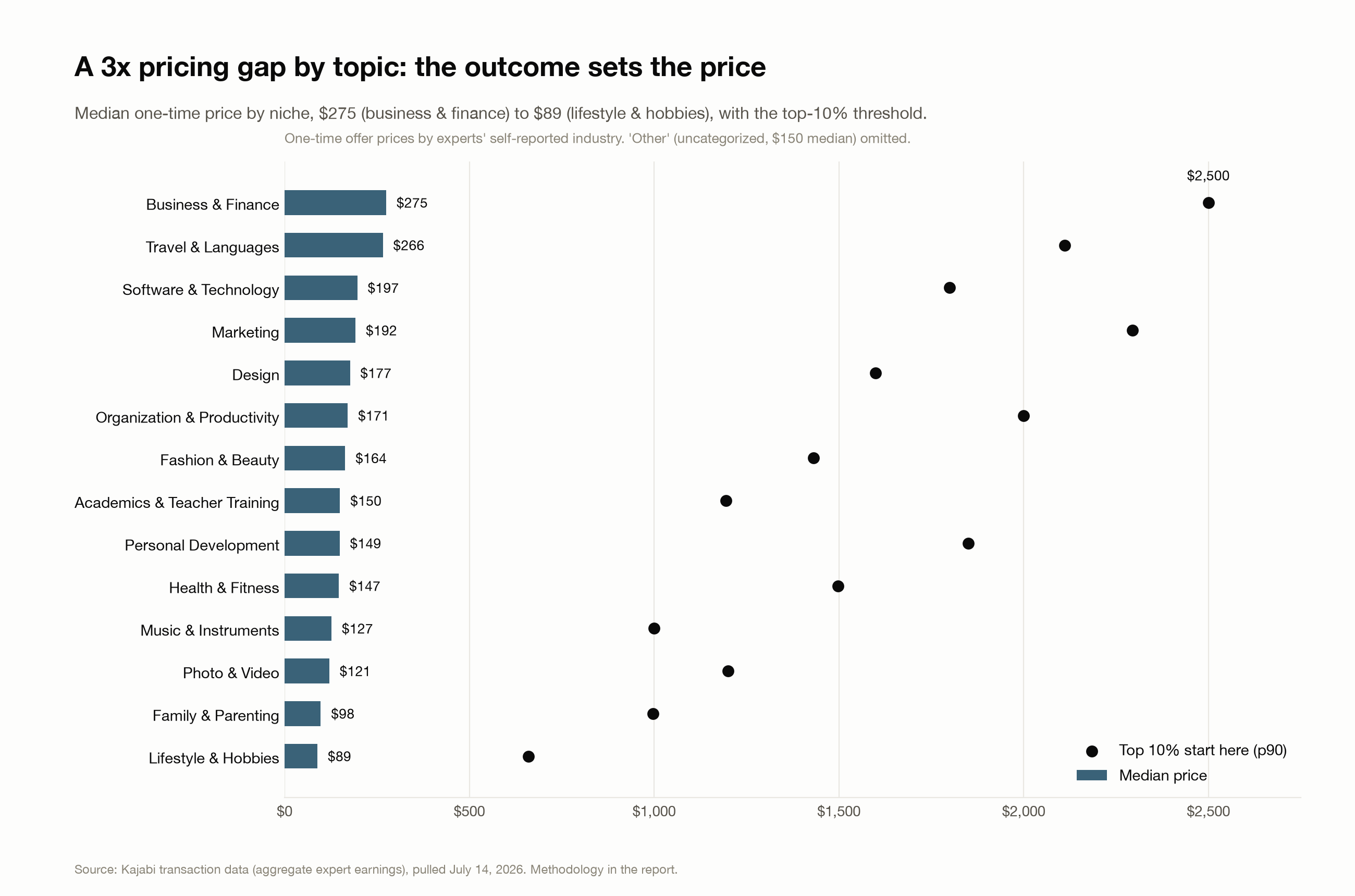
Subscriptions follow the same order: business & finance subscriptions have a median of $131 per payment; lifestyle and hobby subscriptions sit at $47.
There is a 3x pricing gap by topic on Kajabi: business-outcome niches carry a $275 median price while hobby niches carry $89. Why? Because price tracks the economic value of the transformation. A business-finance buyer can do the arithmetic on their investment. A watercolor buyer is purchasing joy, which is worth paying for and priced differently.
Notice what's invisible in this table. Your production effort. Your hours of video. How hard the material was to learn. The market prices exactly one thing: what the outcome is worth to the person buying it.
Two things worth doing with this table. First, find your row and check yourself against the median. If you're below it, you're underpriced relative to your own peers, before any ambition enters the conversation. Second, look at the top-10% column. Someone in your niche... your niche, with your kind of buyer... is charging that number right now.
Find your band: run your offer through the Kajabi pricing calculator.
Take the benchmarks with you. These three tables as a one-page sheet you can keep next to your pricing page... the bands, the staircase, and your niche's medians.
Recurring: the price of a relationship
One-time pricing gets all the attention. The quieter story is what experts charge when the buyer keeps paying.
The most common subscription price on Kajabi is $25 to $49 per payment (21.2% of recurring offers live there). About one in five recurring offers charges under $25. And 12.1% of recurring offers on Kajabi charge $500 or more per payment. Premium recurring is a real market, and a crowded one.
Zoom all the way out and the recurring story gets bigger. At least 42% of categorized expert earnings on Kajabi come from recurring offers. And across all earnings, 53.8% comes from repeat purchases by existing customers. More than half of the money in the expert economy arrives after the first yes.
That reframes what a price is. Pricing is a relationship decision. The number on your checkout page is the opening term of a relationship that, for successful experts, pays two, three, five more times. Set it like it matters beyond launch week, because it does.
The mechanics that move money
Price is the headline. Underneath it sit the mechanics, and the data says they're doing heavy lifting.
Payment plans. The 3-payment plan is the workhorse of the expert economy: $544 million has moved through it. The 12-payment plan is the volume king at 3.4 million individual payments ($444 million), with 6-pay close behind at $403 million. Payment plans are how premium prices meet real budgets... which makes them a pricing tool, and arguably the most underrated one on this list.
The checkout stack. Order bumps and upsells have collected $191 million in add-on revenue on Kajabi, and roughly 15% of sellers use them. The other 85% walk past that money at their own checkout.
Discounting. One in five sales on Kajabi carries a coupon, and the median discount is 40%. Forty. A 40% coupon on a $97 product sells the same work for $58. We're publishing this stat as a caution. A discount is an event... a launch, a deadline, a date on the calendar. Run at this frequency and depth, it's a standing 40% pay cut that trains your audience to wait.
Pay What You Want. Buyers who name their own price pay a median of $15. Fixed-price transactions run $35. PWYW earns its keep as a reach tool for growing an audience. Build your revenue plan on fixed prices.
Digital product prices are rising. Don't anchor to 2023.
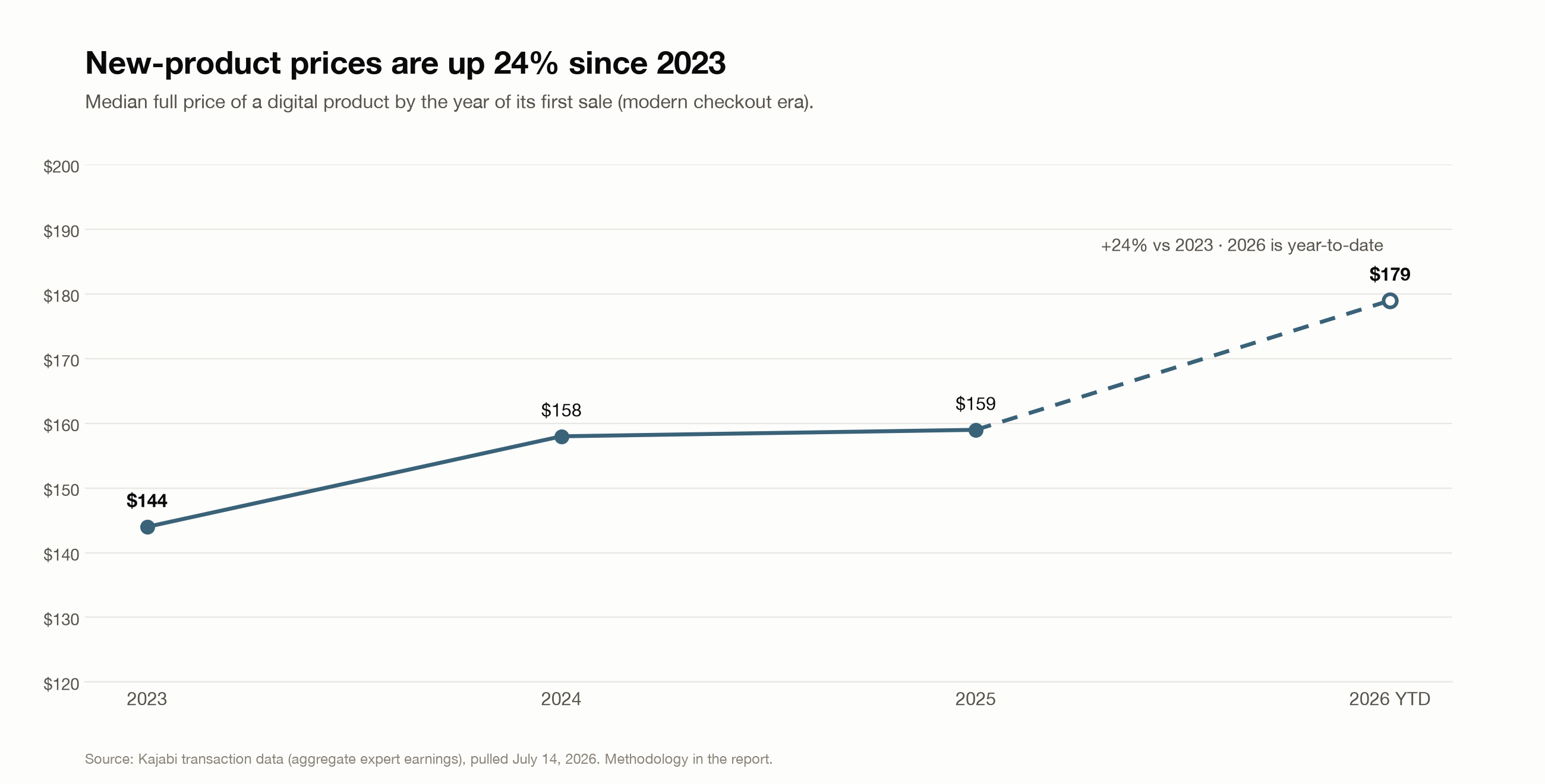
One more trend before the takeaways. The median price of a new digital product on Kajabi is up 24% since 2023: from $144 to $179. The climb has been steady: $144 in 2023, $158 in 2024, $159 in 2025, $179 so far in 2026.
If you set your price in 2023 and haven't touched it since, the market repriced around you. Your "safe" number quietly became a discount.
How to use this
We've watched experts set their first price since 2010, and it taught us where underpricing comes from. It's rarely arithmetic. A no at $27 stings less than a no at $497, so the low price works like armor... it just costs $150,000 of median outcome over the life of the business. If that's you, you're in the majority, and the fix is a decision, and it's available at any time.
Three moves, each anchored to the data above. That's it. No funnels, no hacks.
1. Price the transformation. The vertical table is the proof: the market pays for the value of the outcome, and your production costs never enter the equation. Ask what the change is worth to your buyer... in dollars saved, dollars earned, pain removed, or joy added... and price against that. This is also the #1 pricing advice of our highest-earning customers, and their staircase results back them up.
2. Build toward a premium ceiling. You don't need to launch at $2,500. But the staircase is blunt about where businesses without a premium ceiling end up: a $178 median and a 2.6% shot at six figures. Somewhere in your catalog's future should be the offer for the buyer who wants the full transformation with you closer to the work. Everything else in your catalog can ladder up to it. The mechanics of stacking those rungs are in the done-by-you, done-with-you, done-for-you value ladder.
3. Treat discounts as an event. The current industry default (one in five sales couponed, 40% median depth) is a leak, and most experts running it can't tell you why the coupon exists. Pick your moments: a launch, an anniversary, a genuine deadline. Then let the price be the price.
None of this requires bravado. Charge what the outcome is worth in the niche you serve, revisit the number as you grow, and protect it between events. The experts who do that are, measurably, the ones still standing.
(And if the question underneath all of this is whether selling online courses is profitable at all, we published that data too.)
Methodology
- Source: anonymized, aggregate transaction data from Kajabi: more than $11.7 billion earned by experts across 101 million transactions. Kajabi has operated since 2010; the transaction-level records behind this report cover May 2015 through July 2026. All figures are aggregates; no individual expert's data is identifiable or published.
- "Earnings" means expert earnings (gross sales by experts on the platform, before their costs). These figures describe our customers' businesses. They are not Kajabi revenue.
- Offer price = the median full-price charge for that offer, excluding coupon-discounted sales and payment-plan installments. This keeps a $997 product sold on a 12-pay from looking like an $83 product.
- Coverage: price-point, band, vertical, and trend analyses describe the modern checkout era (2022 forward, 600,000+ products). Lifetime-earnings and repeat-purchase figures use the full history to 2015.
- Verticals are self-reported by experts at signup and cover a subset of sellers; treat those medians as benchmarks rather than a census.
- Causation: where a cut can be read as "do X, earn Y" (the staircase above all), we've said plainly what it does and doesn't show. Premium offers, like deep catalogs, accumulate as businesses succeed.
FAQ
What is the most common price for an online course or digital product?
Across 600,000+ digital products sold on Kajabi, the most common meaningful price point is $97, and expert pricing clusters on a canon of 7-ending prices: $27, $47, $97, $197, $297, $497, and $997.
How much should I charge for coaching or a high-ticket offer?
Benchmark by niche and outcome. Median one-time prices on Kajabi range from $275 in business & finance to $89 in lifestyle & hobbies, and the top 10% of offers in most niches are priced from $1,000 to $2,500+. Experts whose catalog includes a $2,500+ offer reach $100K in lifetime earnings 62.4% of the time.
How much should I charge for a membership or subscription?
The most common subscription price on Kajabi is $25 to $49 per payment. Business-outcome niches run higher (median $131 per payment in business & finance) and 12.1% of recurring offers charge $500 or more per payment.
Do payment plans work?
Yes, at scale: 3-payment plans alone have processed $544 million on Kajabi, and 12-payment plans have collected 3.4 million individual installments worth $444 million. Plans let premium prices meet real budgets.
Should I discount my digital product?
Sparingly. On Kajabi, one in five sales carries a coupon and the median discount is 40%, which functions as a standing pay cut for most experts. Reserve discounts for genuine events with real deadlines.
Are digital product prices going up?
Yes. The median price of a new digital product on Kajabi rose 24% between 2023 and 2026, from $144 to $179.