
A Customer with a Flat Tire Told Her She'd Watched Her Dad and Brothers Do It Her Whole Life and Never Thought She Could
"Who you learn from really matters."
Meg Dietrich figured that out in a small shop in Boone, North Carolina, watching a stranger's day turn around.
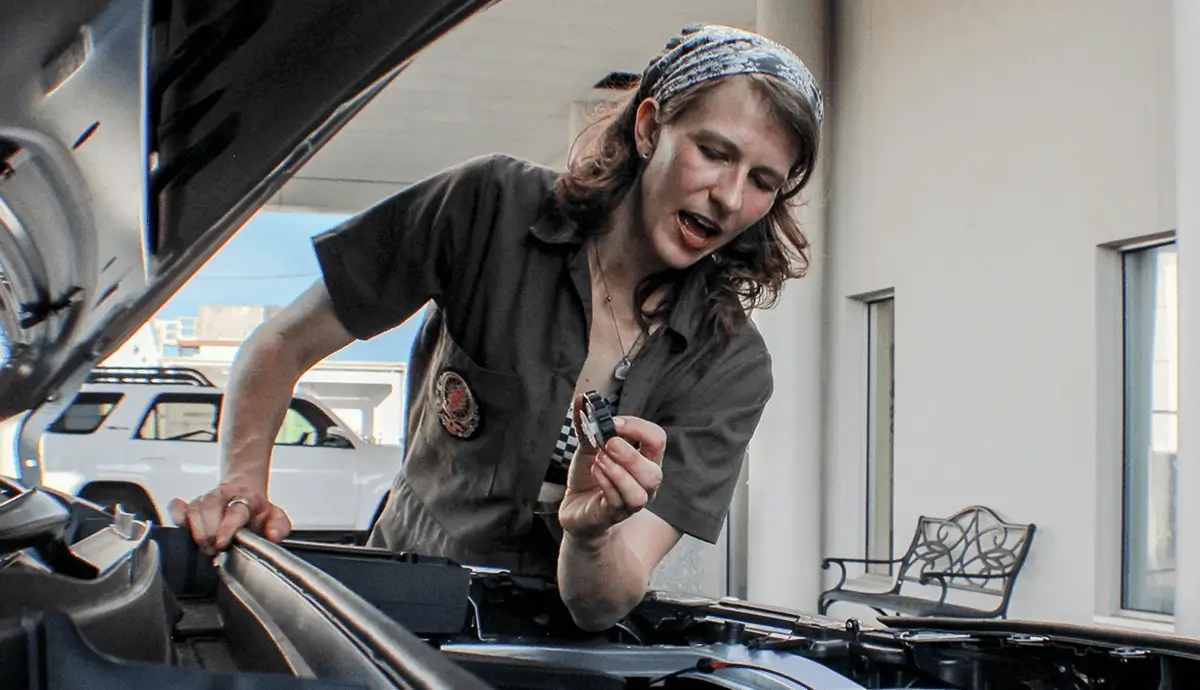
A woman had come in with a flat tire and she was distraught. Whatever else the day had held, this was the proverbial straw that broke the camel's back. Then she noticed who was fixing it.
"When she saw me fixing it, she came over and started asking questions," Meg says. So Meg showed her what she was doing, explained in plain terms why, and told her how to keep it from happening again. The woman's whole demeanor changed. She got energetic. She started smiling.
And on her way out, she said the sentence Meg has been building a business around ever since.
"I watched my dad and my brothers do this my entire life, but I never realized this was something I could do until I saw you doing it."
It was never about the tire, the problem was that she had never seen a version of herself fixing it.
Meg had been a mechanic for years by then. Mechanic school straight out of high school, because she drove a car every day and wanted to know how to fix it. A dealership, then a small mom-and-pop shop, then some traveling. Later, a mechanical engineering degree from UNC Charlotte with a motorsports concentration, chosen partly because she wanted to understand the cars she had been repairing and partly because she grew up watching racing. Then five or six years working in racing itself.
She had the credentials. What she did not have yet was the thing that a woman in Boone handed her, which was a reason.
Before the Business, Her Friends Just Called Her
The demand showed up long before the product did.
"Ever since I became a mechanic, my friends, girlfriends especially, would call me when something went wrong with their car or when they needed to go car shopping," Meg says. "That was always my favorite part."
People kept telling her to open her own shop. She had seen closely enough how shops actually run to know she did not want one. What she liked was narrower and harder to monetize: going car shopping with a friend, giving her enough background that next time she would not need to call at all.
That is worth sitting with, because it is the opposite of how most service businesses are built. The thing Meg enjoyed was making herself unnecessary.
Racing eventually ran its course. It's a fast life, lived on other people's timelines, and she wanted something on her own terms. So she took a job at Mack and Volvo as a design engineer, her first corporate role, sitting at a desk all day and not working with her hands for the first time in her life.
"I realized I needed to be doing something."
A Carpentry Class for Women Showed Her the Shape of It
What brought her clarity was not about cars at all.
Meg signed up for a carpentry class in the mountains of North Carolina that was open only to women. "As soon as I was in that environment, I thought: this is it. This is what I need to be doing, but for cars, with women."
She started with a newsletter, Women's Car Care and Confidence. Then she built the online course, Women's Car Care 101. The desk job she had taken as a bridge turned out to be the thing that funded and scheduled the build, because a corporate job leaves evenings in a way a race season does not.
She needed somewhere to host the course and somewhere to send the newsletter, and she did not want to assemble it out of five separate tools and then maintain the seams.
"I didn't want to over-research and spend six months in analysis paralysis," she says.
One of the first coaches she hired was already on Kajabi and had an affiliate link. That settled it, she had found somebody who could teach her how to use the thing.
"It had everything I needed, it was affordable, and I had someone to teach me how to use it."
One expert's recommendation became another expert's starting point. Meg arrived because a person she already trusted was building on it, which is a pattern she would end up on the other side of soon enough.
The Algorithm Thought She Was Making Car Content for Men
By the time she went to Instagram, she already had proof. The newsletter existed, she had run two live launches of the course, and people had bought. What she did not have was enough people.
"I hit the constraint of audience size," she says. She tried paid ads and ran into the obvious problem: she had more time than money.
The first three or four months were daily posting and a fight she had not anticipated. She was making car content, so the platform served it to men, and a chunk of the internet arrived in a mood.
"As soon as it figured out I was making educational content for women, it skyrocketed," Meg says. "Once it understood I wasn't trying to antagonize men on the internet, I was trying to empower women who wanted to learn, that made all the difference."
She sat at 35,000 to 45,000 followers around the five- or six-month mark. Then one post went viral. Within seven or eight months she was roughly where she is today, past 550,000, and she had cleared 400,000 to 500,000 inside her first year of posting. All of it organic, all of it on one platform.
The post itself was slight. A sing-songy audio clip from a TV musical, her face panning across it, and a caption laying out the résumé: mechanic, mechanical engineering degree, racing, and now teaching women about their cars. A man turned up in the comments to say she was doing it for attention.
"So it was kind of an antagonizing thing, ironically. But it got a lot of views and it established credibility."
The viral post did not build the audience, it told the algorithm who she was teaching, and the audience followed from that.
Her read on why any of it stuck is not really about cars.
"That's why my handle is Meg Drives Confidence. You're learning about your car and gaining practical life skills, but underneath everything is confidence in yourself," she says. "Learning to take care of my car built my confidence, not just as a mechanic but as a woman moving through the world."
Which is also the answer to where the intimidation comes from in the first place. Cars are male-dominated, and the gap is wider than gender: plenty of people want to take care of their car without any ambition of becoming a mechanic.
"You do not have to be a mechanic to feel confident and in control when it comes to taking care of your car, going car shopping, or making sure you're not getting ripped off."
What she teaches is what she calls a foundational level of car care knowledge, something you pull from for the rest of your life. Not expertise. Enough footing to ask a better question.
Selling the Course Directly Did Not Work, and Fixing That Took Three Years
The version that works now took three years, and Meg can name every step that didn't. At first she simply sold the course. Traffic went to the sales page and the sales page asked customers for money.
"That wasn't working," she says. She added a video, which sort of worked, not really. Then she realized she needed a webinar and launched her first one. Her live webinars now do most of the heavy lifting.
"Year one was learning that I can't just say buy my online course, buy my online course. Every once in a while someone will, but not consistently."
Paid ads to the webinar taught her the next thing. People will absolutely sign up for something free, but cold traffic converted far worse than her Instagram audience did. So she went looking for advice again and came back with a different idea: build something low ticket that people barely have to think about buying, and use it as the door.
That turned out to be the mechanism.
"The women who buy my complete car buying guide buy my online course at a much higher rate than the women who just sign up for my newsletter."
A cheap purchase is a better qualifier than a free signup. Someone who has paid once has already decided you are worth money, which is a different decision from deciding you are worth an email address.
The funnel now reads: newsletter with a warm-up sequence and something every week, a low-ticket guide with its own sequence before subscribers drop into the regular rhythm, a special or a webinar roughly monthly, and the course at the end of it. Her main calls to action are the newsletter and the guides, not the course.
What fills all of it comes from asking.
"What do you want? What do you have questions about?" That is how she builds the newsletter, picks webinar topics like Three Common Car Noises: Is It Serious or Safe to Drive?, How to Find a Trustworthy Mechanic and Never Get Ripped Off Again, and The Car Decision Nobody Taught You: When to Fix, When to Buy, and What to Look For, and how the course has grown over three or four years. Someone says a topic was not covered, and she adds lessons.
And the whole thing is built to wait. A woman buys the car buying guide, actually buys the car three months later, and only then starts wondering how to look after it. The course is there when she gets to it.
She built the audience before she figured out the business, and then spent three years fixing the business.
What She Teaches Today, and What She Is Building Next
Women's Car Care 101 now runs as a newsletter, an online course, monthly live webinars, and a set of digital guides including the complete car buying guide. Instagram automation routes people from comments and DMs to a Kajabi page to join the newsletter or register for a webinar.
She has also started taking it offline. A couple of hands-on workshops have run already, and she is clear about why they matter.
"There's something really special about taking an online interaction and bringing it in person."
The plan is regular workshops where she lives, then pop-ups elsewhere with local businesses and other creators, since her audience is spread across the US and beyond. Beyond that: a group coaching container for women in the middle of buying a car, thirty or sixty days with weekly access to her honest opinion. Platform expansion past Instagram. Partnerships and podcasts.
Every one of those came from the same question.
"What are you struggling with, where do you need help, and how can I build something around that?"
Amplify is on the list too. She has filled out her profile and started working through the recommended matches, though with webinars running this month and October dates still being finalized, she has not set up a promotion yet.
She already knows the premise works, because it's how she got here. A coach she trusted was building on Kajabi, and that's how Meg found it.
Her Advice, If You Are the Only One Who Looks Like You
Meg gets asked this a lot, and her answer is not hedged.
"Whether she's on the fence about joining an industry or teaching in one where she's been the only woman, the only person of color, it's all the more important that you do it."
She has lost count of the messages. Women telling her they were scared, and then saw her doing it. Women telling her they have never changed a flat tire but now know that they could.
"It ties back to that story. I didn't realize I could do it until I saw you doing it."
She is honest that it costs something. You need thick skin and you will meet resistance. Her experience, for what it is worth, is that most of it does not come from where you would expect.
"Nine times out of ten, the men, even the grumpy old ones, are more welcoming than not."
The reason to do it is the person who has not seen it done. Which is the same thing a woman with a flat tire told her in Boone, years before there was a business to build out of it.
Frequently Asked Questions
Do you have to be a mechanic to take care of your own car?
No, and Meg's position is that treating it as all or nothing is the problem. She teaches what she calls a foundational level of car care knowledge, enough to feel in control at a repair shop or a dealership and to know when to ask a further question.
How do you grow an organic audience without paid ads?
Meg posted daily for months before it worked, and the turning point was clarity about who she was teaching rather than what she was teaching. She also surveys her audience constantly and builds content from what they ask for.
Why sell a low-ticket product instead of your main course?
Because a small purchase qualifies someone better than a free signup does. Meg's buyers of a single low-ticket guide go on to buy her course at a much higher rate than newsletter subscribers, so her main calls to action point at the guides and the newsletter.
Can you build this while working full time?
Meg built the newsletter and the course while employed as a design engineer, and did not go full time until April 2026, roughly two and a half years after the first newsletter went out.
What does Women's Car Care 101 include?
A newsletter, an online course, monthly live webinars, and digital guides including a complete car buying guide, plus in-person workshops.
Ready to Build Something of Your Own?
Meg's next webinar, 3 Common Car Noises: Is It Serious, or Safe to Drive?, runs Thursday November 12 at 11am ET and Saturday November 14 at 10am ET. Registration goes out to her newsletter subscribers, so sign up at womenscarcare101.com.
Before any of this was a business, her friends were just calling her when something went wrong with their car. If people already call you for the thing you know, that is the business, you just have not built it yet.