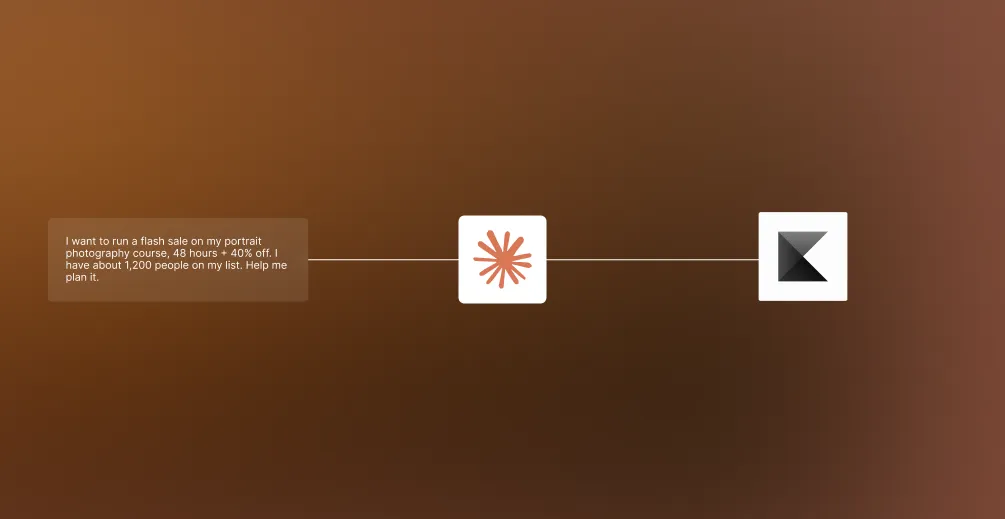

Most Heroes who pick up Kajabi MCP use it for the things the demo is about — flash sales, blog posts, email broadcasts, the work that used to take an afternoon and now takes a sentence.
A smaller cohort uses MCP differently. These are the teams running serious membership businesses on Kajabi, operations large enough that custom builds, theme work, and integrations into their own internal tooling are part of the normal week. For these teams, MCP is not a faster way to do what they already do. It is a different shape of platform access. It changes what is possible to ship, not just how fast they ship it.
This team used MCP to deploy a custom Launchpad builder, a custom portal builder, a content library, a membership surface, and personalized journey pages — all live inside their Kajabi instance, all within ten minutes of the working session. They updated the themes on the fly, in code, the same day. The week after, they hooked their own internal tools into MCP and were deploying custom themes by commenting on a project management ticket.
What this team's setup looks like
The membership team runs a business with several thousand members across multiple programs. Their Kajabi instance is the front door — the surface members log in to, where their journey through the program plays out, the surface that has to feel branded and intentional from the first click.
For a team at this scale, customization is not optional. The custom Launchpad layout, the portal structure that reflects their program model, the personalized journey pages that adjust based on member stage — these have historically required either a developer on staff or an agency relationship. What they wanted was the ability to make those custom changes inside Kajabi without a round trip through their developer queue or an external partner.
The 10-minute working session
They sat down, opened Claude with Kajabi MCP connected, and worked through the build in conversation. They deployed a custom Launchpad builder, built a custom portal builder, set up a content library, configured a membership surface, and built personalized journey pages that adjusted based on member stage. All of it went live inside Kajabi within ten minutes.
The thing that was actually new wasn't the speed — though the speed was real — but the working pattern. They were describing what they wanted in conversation, and the assistant was building it inside Kajabi as they talked. The build was the conversation. For an agency or a developer, the equivalent build would have been a multi-day project.
Updating themes on the fly
After the initial build, they updated the themes on the fly, in code, while still in the conversation. Theme work has historically required a developer to leave the conversation, open the codebase, make a change, push it, watch a deploy, and come back. With MCP, the team described the changes they wanted and the changes deployed without anybody opening a separate code editor. The feedback loop tightened to the point of being instantaneous.
The week after: their own MCP, hooked into their own workflow
This team uses ClickUp for project management. After their first week with MCP, they hooked Kajabi MCP into their internal tooling. A team member could comment on a ClickUp task with a description of the theme change they wanted, and the change would deploy inside Kajabi without anybody opening Claude or Kajabi directly. The comment was the trigger. The deploy was the outcome.
This is power-user territory and requires a team with the technical fluency to wire MCP-based tooling into a workflow. What their experience demonstrates is the upper bound of what MCP makes possible.
What MCP did, and what it didn't
MCP did: build the custom surfaces based on the team's instructions; update theme code on the fly; and operate as a tool the team could integrate into their own internal workflow. Even in this fast-moving session, the team reviewed each step and approved changes before they went live. MCP did not process payments or touch sensitive financial data. It did not operate as a substitute for the Kajabi admin. It did not replace the team's developer judgment — MCP made the implementation faster; the architectural decisions stayed with the people running the business.
The shape of "what's possible," redrawn
Before MCP, this team's roadmap was constrained by implementation costs. Some custom work was worth the developer time. Most was not. After MCP, the implementation cost of most custom work collapsed. Things that had been off the roadmap moved onto it. The team's ambition adjusted to match the new ceiling. It is not "we ship faster." It is "we ship more things, because more things are now worth shipping."
If you don't know Kajabi MCP, you don't know Kajabi.
See Kajabi MCP in action → kajabi.com/mcp