
The pitch for Backstage usually starts with the private client portal, the curated path, the assignment tracking, and the personalized delivery. That's the structural part of the story.
The behavioral part of the story — the part that changes how Heroes actually run their coaching businesses day to day — comes from two smaller features that don't get the marquee treatment they deserve.
The first is voice memo transcription. The second is AI-generated session summaries. Neither one is the headline. Both are the reasons the headline works.
The feedback gap that voice memos close
Most coaching relationships have a feedback gap. The session ends. The expert has notes about what the client should work on. Getting those notes from the expert's head into the client's hands is where the gap sits.
The traditional ways of closing it all have costs. Typing notes after sessions becomes an unpaid second job by session four. Recording video debriefs doesn't work for most coaches in a moment of quiet thought. Sending a voice note over WhatsApp works in the moment but not for the client who later wants to find the one sentence that mattered in a four-minute audio file.
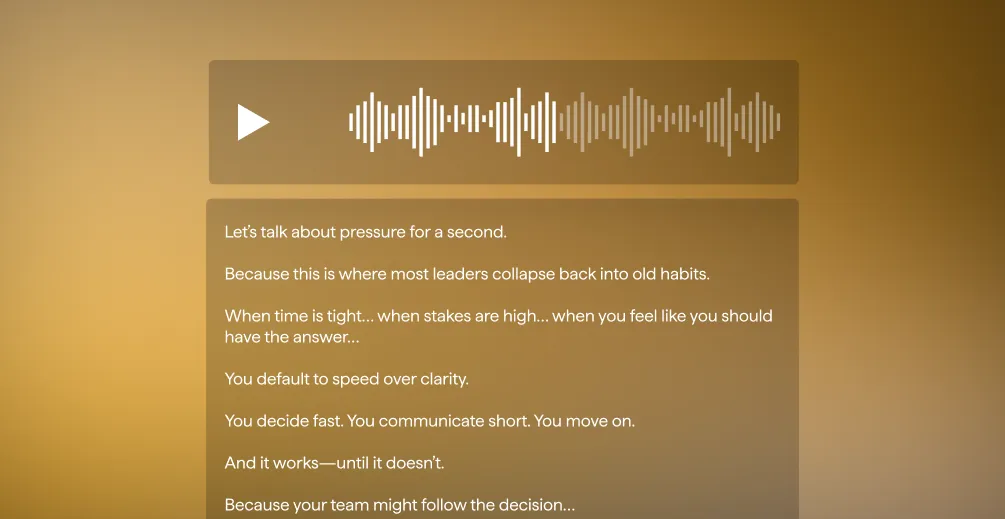
Voice memo transcription in Backstage closes this gap by removing all costs. The expert holds up their phone, records a two-minute note, and sends it. The audio appears in the client's portal. So does a clean transcription, generated automatically in seconds. The client can listen, read, scroll back to the part that matters, and act on it without replaying the whole thing.
The shift is small in feature terms and large in behavior terms. Heroes who used to write up session notes once a week now leave voice memos two or three times a week. The feedback loop tightens. The client gets more value. The coach does less typing.
What the AI does and does not do
The AI transcribes the audio. It does not respond to the client on the expert's behalf. It does not suggest what the expert should say. It does not generate a fake voice memo. The expert is recording. The transcription is the accommodation for the client who would rather read.
This restraint is a deliberate part of how Backstage is designed. Every piece of the client's program is hand-placed by the expert. AI transcribes. AI summarizes. The expert curates. The voice in the portal is the expert's voice. Heroes can charge premium prices for Backstage because the relationship is real.
Session recordings and AI summaries
Heroes who run live coaching sessions can have those sessions recorded inside Backstage. The recording lands in the client's portal. Alongside it, an AI-generated summary appears: a short text document that pulls out the main points of the session, the practice items the client agreed to, and the questions left open.
The summary doesn't replace the recording. The recording is there for the client who wants to hear the session again. The summary is for the client who wants the takeaways without re-watching the hour. Most clients want both, at different times.
For the coach, the summary changes how the next session opens. Instead of "let's see, where were we last time," the coach opens the client's portal and reads the summary in thirty seconds.
Three habits these features change
The space between sessions becomes productive. With voice memos, the coach can drop in once or twice during the week to keep the loop tight. The client feels the relationship instead of feeling the gap.
Session prep stops being unpaid work. Reading a 200-word AI summary before a call takes thirty seconds. The summary is the prep, and it produces itself.
The client's portal becomes a record of progress. After ten sessions, the portal contains ten recordings, ten summaries, and all the voice memos. The client can look back at week one and see how far they've come. The coach can review the same record to see what's working in their practice.
What these features deliberately don't do
There is no AI coach that responds to the client between sessions. There is no group analytics dashboard that ranks clients by progress. There is no gamification. There are no algorithmic recommendations for what content to assign next. The expert chooses. These omissions are not accidents. They are what allow Backstage to be priced as a transformation rather than information.
How Heroes use these features in practice
Keep voice memos short — a two-minute note that lands tomorrow is more valuable than a fifteen-minute monologue that lands next week. Use the transcription to find the line that matters. Treat the session summary as the start of the next session. Reference the portal in your voice memos: "Look at the assignment I added to your path this morning" turns the memo into the start of the next action.
If you don't know Backstage, you don't know Kajabi.
See Backstage in action → kajabi.com/backstage