
She had blocked the afternoon for content. Three hours, on a Wednesday, to draft the blog posts she had been promising her audience for the last quarter. The list was twenty articles long. She had been adding to it for months — topic ideas pulled from her live cohorts, frequently asked questions from her email list, threads from her social accounts that deserved fuller treatment. Each was a piece of content her audience would have read. None of them were written.
She knew the math of why. Each blog post took two to three hours — drafting, pasting into Kajabi's editor, reformatting, adding the headline, the meta description, the categories, saving as draft. Twenty posts at two hours each was forty hours of work. The afternoon block was a polite fiction. She wasn't going to draft twenty posts in three hours. She was going to draft two.
Three hours later, she had twenty drafts inside Kajabi. All of them were ready for her review. All of them queued for editing and scheduling at the pace she actually wanted to publish them.
The thing she had used to compress a quarter's worth of work into a single afternoon was Kajabi MCP.
What she had been doing before
Before MCP, her content workflow had a specific shape. She would draft an article in her writing tool of choice, copy it, open Kajabi, navigate to the blog section, click "new post," paste the body, reformat the headers, write a title, write a meta description, add tags, pick categories, save as draft. Twenty minutes of mechanical labor per post. Twenty posts at twenty minutes each was nearly seven hours of pure friction — the gap between "I have a draft" and "the draft exists in the place it needs to exist."
The conversation that compressed it
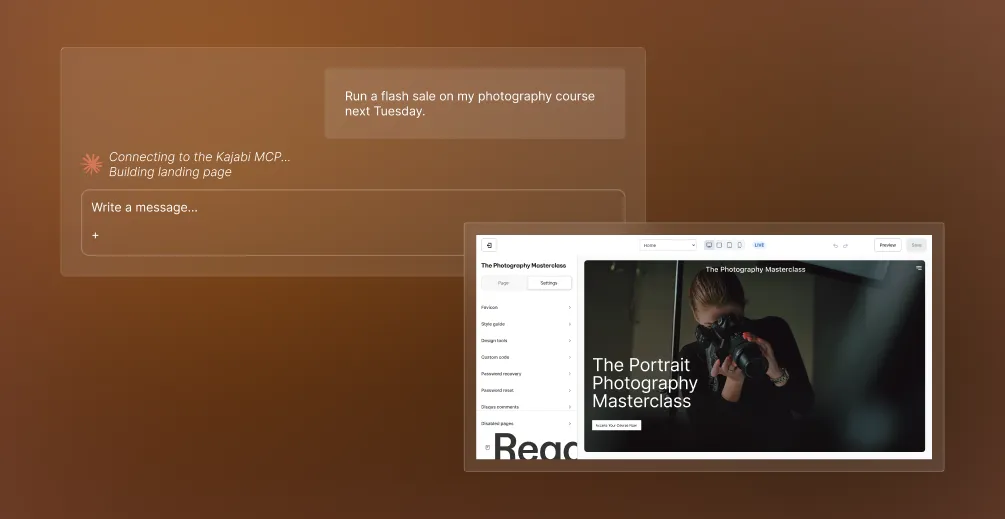
When she set up Kajabi MCP, her existing AI assistant could now also create drafts directly in Kajabi. She handed it the list of twenty topics, told it to draft each one to her usual length and structure in her voice, and told it to create each draft as a blog post inside her Kajabi account with appropriate titles, meta descriptions, and category assignments.
It went to work. She watched the count climb — three drafts, six drafts, twelve drafts. Each one was created inside Kajabi as a draft post, ready for her review. Mid-process, she paused to refine her instructions. The next four drafts came back tighter. By the end of three hours, all twenty posts existed inside her account.
What MCP actually did, and what it didn't
MCP did: follow the instructions from the AI assistant and execute them in her Kajabi account; create the blog posts as drafts with all metadata populated; and save the drafts inside her account where she could see them in the standard blog post list.
MCP did not: publish anything on her behalf (every draft was a draft); replace the Kajabi admin; or operate as a Kajabi-branded chat tool. The conversation took place within the AI assistant she was already using.
The expert is in the loop. MCP drafts and builds. The expert reviews and goes live.
The number that mattered
Twenty drafts. One afternoon. That is the number that changes how the expert thinks about content production for the rest of the year. Before MCP, her quarterly content list was a wishlist she completed thirty percent of. After MCP, it's a working roadmap she completes nearly all of.
Another Hero used MCP to set up ten draft email broadcasts in 60 seconds, work that previously took 20 to 30 minutes. A team deployed a custom Launchpad and portal builder live inside Kajabi within ten minutes. The pattern is consistent: the work that used to be the gap between "I have an idea" and "it exists inside Kajabi" is the work MCP eliminates.
What the review looked like
The drafting compression doesn't mean review compression. She spent the rest of that week reviewing the twenty posts the way she would have reviewed two — line by line, in her own voice, with her own judgment. Some she shipped close to as-written. Some she rewrote substantially. A few she trashed. The expert decides what goes live. MCP gets the drafts into position.
The rhythm change
Before MCP, she published when she had three hours together, which was rare. After MCP, she published when she had an idea, because the gap between "I had an idea" and "the draft is sitting in Kajabi waiting for me" closed to a single sentence. Three of her launch ideas from the previous quarter — the ones that had died because the setup felt like too much friction for something she wasn't sure would work — came back to life.
If you don't know Kajabi MCP, you don't know Kajabi.
See Kajabi MCP in action → kajabi.com/mcp