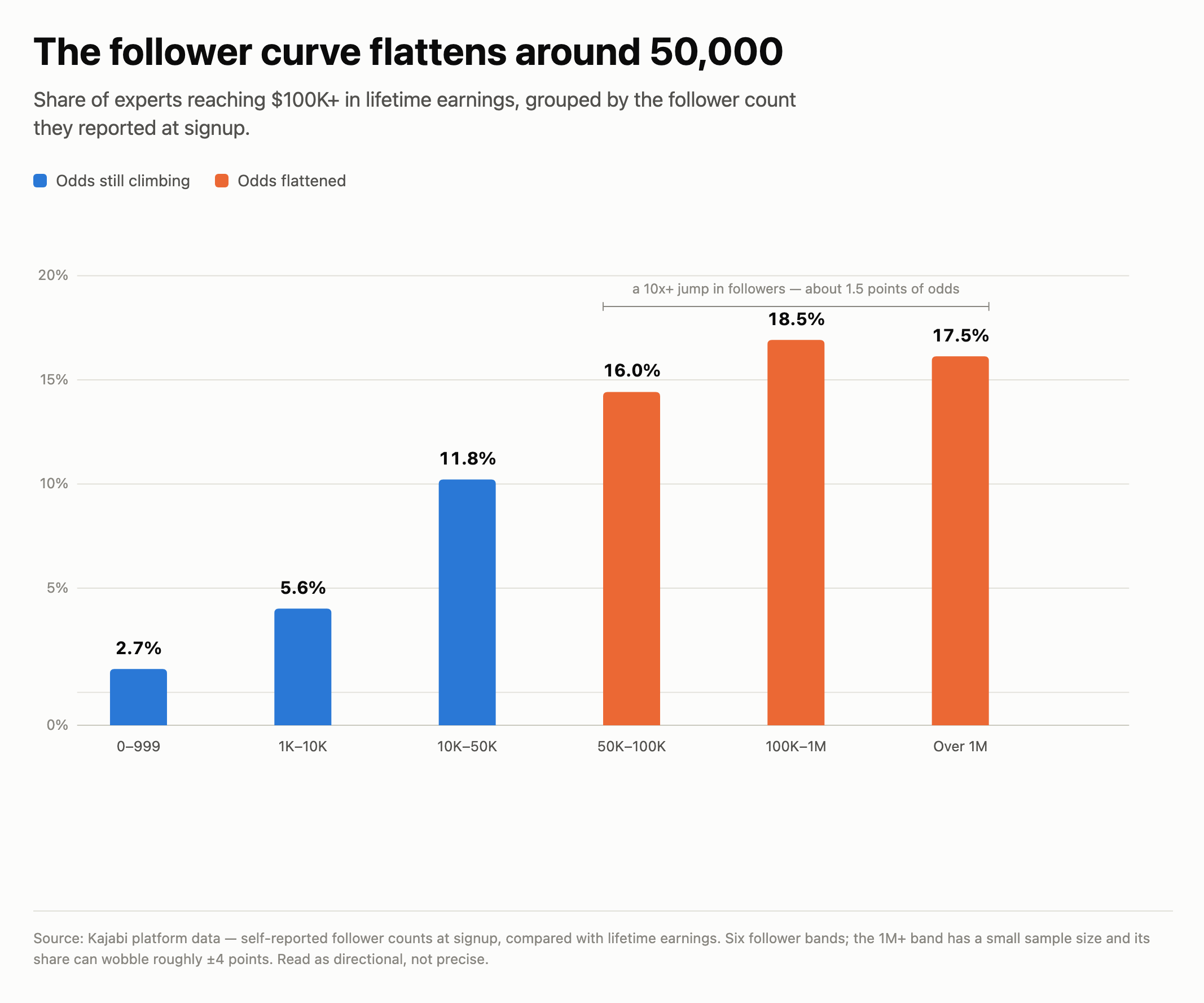
Among experts on Kajabi who have made at least one sale, 2.7% of those who signed up with fewer than 1,000 followers have earned $100,000 or more. The odds rise with starting audience size up to about 50,000 followers, then flatten: experts who arrived with 50,000 to 100,000 followers reach six figures 16.0% of the time, and experts who arrived with more than a million followers reach it 17.5% of the time. A million followers buys roughly the same odds as sixty thousand. Audience size helps until the 50K to 100K range, and past that point it mostly stops helping.
We can print that curve because we own the data. Kajabi has been running since 2010, the total now stands at more than $11.7 billion earned by experts on Kajabi, and when experts sign up, we ask how big their following is. So we can do the thing no follower-growth guru can do: put day-one follower counts and eventual earnings on the same chart.
One thing this data assumes about you: you have expertise people would pay for (a skill, a method, a result you know how to produce), and you're wondering whether your audience is big enough to sell it.
The shape of the answer surprised us too.
The follower curve, all six buckets
Here's the full staircase. Denominator first, because it matters: this is the share of experts who reach $100,000 or more in lifetime sales, among experts who have made at least one sale, grouped by the follower count they reported when they signed up.
Two honesty notes before you screenshot the table:
- Follower counts are self-reported at signup. People round up. Counts drift after day one. Treat the buckets as "roughly where you started," and treat the shape of the curve as the finding, since the shape survives fuzzy inputs.
- The 1M+ bucket is small. Few people with a million followers sign up for anything, so that 17.5% could wobble about four points in either direction. Which is why we describe the curve as flattening: from the 50K band up, the odds hold roughly level, wobble included, however famous you get.
Now walk the staircase from the bottom. Zero to 999 followers: 2.7%. Cross into the 1K to 10K band and the odds double to 5.6%. The 10K to 50K band doubles them again, to 11.8%. Then 16.0%. Then the stairs end and you're walking down a hallway: 16.0%, 18.5%, 17.5%. Between the 50K band and the 1M+ band, the audience multiplies by more than ten, and the odds move about a point and a half... inside the margin of wobble.
Do you need a big audience to sell online courses?
No. You need enough of the right people, and "enough" arrives far earlier than the influencer economy would have you believe.
And the answer is wider than courses. This curve counts every kind of expert business on the platform: coaching practices, paid communities, consulting shops, certification programs, and yes, courses. A course is one of five models for selling what you know, and if you're still deciding which model fits you, start with how to choose among the five business models for selling your expertise. The follower question sits upstream of all of them.
Look at both ends of the curve. At the bottom sit the experts who signed up with next to no audience: 2.7% of them, 27 in every thousand, ended up past $100,000. Long odds, no argument. What matters is that the group exists at all. Starting from almost zero leaves the door wide open.
The top end is the part we find funnier. Somewhere around 50,000 followers, the market stops paying for reach. An expert with 60,000 followers and an expert with 1.2 million followers are playing for roughly the same odds. If audience size were the variable that decides this game, that result would be impossible.
So fame turns out to be a weak predictor, which is exactly what you'd expect in an expert economy. What predicts better, in everything else we see across the platform: whether you have offers people can buy, how you price them, and whether the people who follow you are the people your business serves. If you want the earnings side of that story, including the typical-seller number most platforms would rather skip past, start with what course sellers typically earn.
Why does the curve flatten around 50,000 followers?
Because followers and customers are two different populations that happen to overlap.
A business built on expertise sells a way out of a specific stuck place (out of shape, unfunded, overlooked for promotion... pick your niche). You know the route out, and people pay you to walk it with them. Your market is the set of people in that exact stuck place who trust you to lead them.
Follower growth past a certain size recruits a different crowd: spectators. People who enjoy watching you. They like the posts, they share the reels, and they will never buy the thing, because they were never in the stuck place you fix. Fame scales the spectators. The buyers... the people with the problem, who can find you and trust you... top out much earlier. Our read of the flattening: somewhere around 50K, most experts have already reached about as many of their buyers as broad social reach will ever deliver. After that, the follower count goes up and the odds hold still.
We watch the failure mode this creates every week. An expert with real knowledge disappears for half a year to perfect a course: studio lighting, worksheets with a table of contents, an email automation mapped out to the minute. Meanwhile the audience is a few dozen followers, half of them relatives, and the email list doesn't exist yet. Building product feels safe (nobody can reject a course that isn't for sale). Finding your people means getting told no in public. So the expert polishes, the audience stays microscopic, and launch day sounds like a tree falling in an empty forest. The full autopsy of that pattern is in why most online courses never sell.
The curve hands you the assignment in the right order: gather enough of the right people somewhere you can reach them directly (for most experts, an email list), then spend your energy on the business itself. A threshold audience is a project with a finish line, and the finish line is a count of reachable buyers, whatever number sits under your profile photo. Fame has no finish line, and the data says the prize at the end of it is a point and a half.
"But every seven-figure creator I see has a massive following."
You see them because they're massive. The six-figure knitting-pattern seller with 4,000 email subscribers never crosses your feed, and she doesn't care. Survivorship bias with a ring light.
"So a big audience is bad now?"
Big is fine. The climb from 2.7% to 16.0% is a six-fold improvement in odds, and it's real. Our claim is about the ceiling: past the 50K band, another zero on your follower count stops moving the number, so chasing it becomes a hobby you fund with your business's time.
What should you build instead of a bigger following?
A threshold of the right people, on a channel you control. Two moves, in order.
Count what you have. Tally every channel: email list (count only the subscribers who still open), Instagram, YouTube, podcast downloads, the Facebook group you started in 2021 and quietly abandoned. Then apply the filter that matters: how many of these people have the problem you solve, and how many can you reach without renting a platform's permission? That number... call it your real audience... is usually much smaller than your follower total and worth ten times more. Most experts inflate it three ways at once: scoring a passive follower as a future buyer, tallying one superfan on three platforms, and giving a dormant list full credit years after the last send. The honest number stings. It's also the only one you can build on.
Move followers onto a list you own. Social followers live on platforms that decide, daily, whether you get to talk to them. Email subscribers are yours. If the follower curve flattens, the practical response is to make the reach you already have deeper: trade profile visits for email addresses. We did the math on that trade in 2,000 email subscribers beat 10,000 followers, and it isn't close.
The follower curve is very good news wearing a disappointing costume. If the odds kept climbing forever with audience size, the winners would already be picked, and they'd be the famous ones. The curve says everyone from 60,000 followers up to seven figures is playing the same game, and the variables that decide it (your offer, your pricing, your people) are variables you control. The game requires a threshold, and a threshold is something you can start building this afternoon.