
She had spent two decades teaching painting. Most of those years had been in a studio she rented by the hour, with students who showed up in person and paid in cash. The income was steady. It was also capped. Her in-studio classes could only hold so many people, and her week could only hold so many classes.
She had been told for years she should put her teaching online. She had ignored the advice for almost as many years, because every version of "putting yourself online" she had heard sounded like building a separate business she would have to learn to run while still running the one that paid her bills.
When she finally opened a Kajabi account, she did it on a Sunday evening, in a moment of "maybe I'll just see what this looks like." She did not have a plan. She had a list of paintings she had taught from, a notebook of student questions she had answered hundreds of times, and a working theory that people who had taken her classes would buy the digital version, too.
Five days later, she made her first sale. Two months later, she had 10 offers live and more than $20,000 in revenue from her online business.
The first conversation
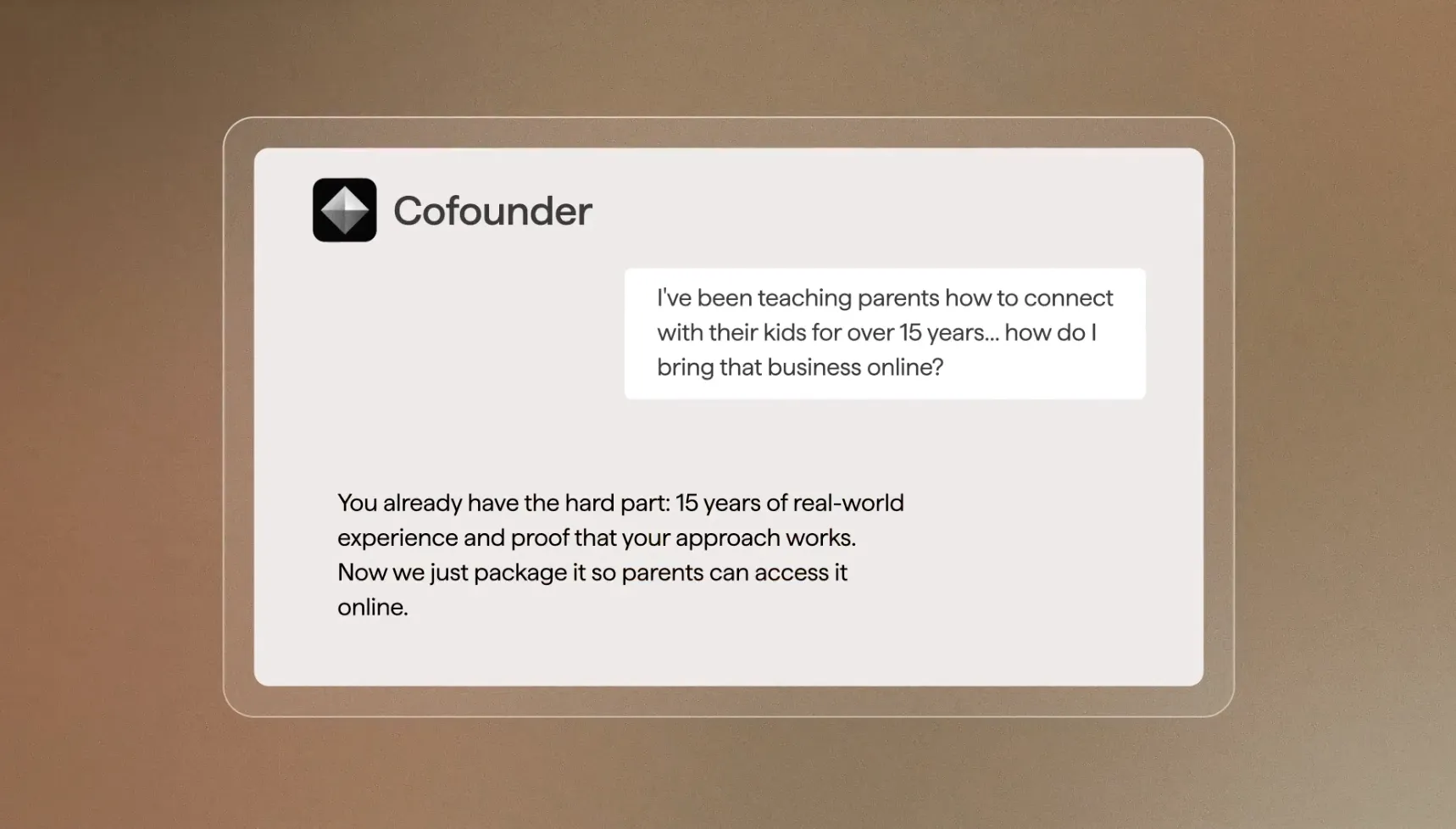
When she opened Cofounder for the first time, she described what she taught the way she would have described it at a dinner party. By the end of that first conversation, she had three potential first offers: a foundational technique mini-course, a single-painting walkthrough, and a longer starter-kit bundle that combined them. She picked the mini-course. Cofounder helped her draft the sales page that night. She edited the copy in her own voice the next morning. Five days after she opened Kajabi, she made her first sale.
The pattern that produced ten offers
Cofounder was the partner she went to whenever she had an idea. A new offer for the holidays — three days from "what if I made a holiday gift bundle" to a published offer. A standalone painting tutorial spun out from a question her local students kept asking, written and shipped in a weekend. A subscription tier for her most engaged buyers, live within a week.
What had previously been an idea-killing rhythm became a working cadence. Ideas became offers. The decision-to-shipped time, with a partner who knew her business and could draft the work into existence, collapsed.
What Cofounder did at each step
Across the ten offers, Cofounder's role was consistent. It helped her shape each offer before she built it — pricing, audience, positioning, structure. It drafted the copy: sales page, welcome email, customer support email, descriptive language for the offer page. She edited every piece in her own voice. It pointed her to the right pages inside Kajabi. It picked up open threads from earlier sessions: when she said she wanted to add a downloadable color reference card as a bonus, Cofounder brought it up unprompted in a later session. It did not publish anything on her behalf.
The piece she didn't expect
She had expected to make a course. She had not expected to learn how to run a business online. By offer five, she was thinking in terms of customer journeys. By offer eight, she was making decisions based on what she had learned about her own buyers. By offer ten, she had a business that generated revenue every week.
The first month is about getting an offer live. The second month is about the working pattern of being in business — the kind of thinking that traditionally takes new entrepreneurs a year to develop, because they have nobody helping them see it.
The numbers, in context
Five days to the first sale. Ten offers in under two months. More than $20,000 in revenue. The first number is what most new Heroes care about — the longest stretch in a new business is the one between signing up and earning. The second number is what changed the shape of her business. The third number is what made the practice sustainable and funded her decision to teach less in the studio and more online.
A delivery question worth asking
By offer ten, she had a different problem from the one she started with. She had buyers across a range of price points, some of whom were starting to ask for more than the courses delivered — feedback on their paintings, accountability between practice sessions, a way to ask questions and get answers. That is the kind of problem Backstage is built for.
If you don't know Cofounder, you don't know Kajabi.
See Cofounder in action → kajabi.com/cofounder