
She had been teaching music online for almost two years. Her course library was good. Her students said so. The reviews said so. The completion rate, when she went looking for it, did not say so.
She knew what was happening because she had lived it before, in person, with private students who paid her by the hour. Music doesn't work as a one-way broadcast. The student plays. The teacher listens. The teacher adjusts. The student plays again. That feedback loop is what teaches a person to play an instrument. A pre-recorded course is the part where the teacher talks. The rest of the loop is missing.
So she had been improvising. She ran a Facebook group for her students. She did monthly live Q&As over Zoom. She sent voice notes through WhatsApp to a handful of advanced students who had her number. She kept a spreadsheet of who had asked what so she could remember to follow up. None of it cohered. All of it was unpaid work she was doing on top of the course she had already sold.
She knew the students who got real results were the ones she touched personally. She knew that touch had a price most of her students would happily pay. She also knew her current setup couldn't bear it. The duct tape was already slipping.
She launched Backstage on a Tuesday. By the end of that month, she had signed three private clients at premium rates and built $6,500 a month in new recurring revenue on top of her existing course business.
The change in shape
Before Backstage, the music educator's business was shaped like a course library. Students paid once, accessed the lessons, and her involvement ended at the login screen. Anything she did beyond that was a service she was layering on top of a product she had already shipped.
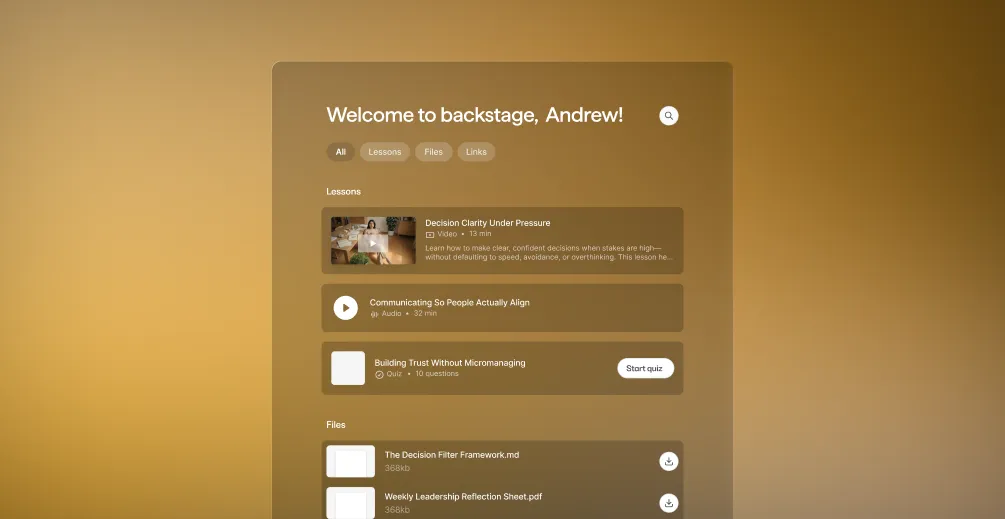
After Backstage, her business was shaped like a private studio. Each high-value client had their own portal, with content curated specifically for their level and goals. Assignments waited for them. Voice notes from her arrived between sessions. Their last live session was recorded, summarized, and sitting in their portal alongside a list of what to practice for next time.
The structural shift mattered more than the technology. Backstage doesn't replace courses. Courses still deliver information at scale. Backstage delivers transformation one client at a time.
Three clients in three weeks
She didn't try to convert her entire course audience to Backstage. She picked three.
The first was a longtime intermediate student who had repeatedly asked for one-on-one feedback. She offered him a Backstage portal at $1,500 a month. He said yes that day.
The second was a student preparing for an audition. The Backstage portal was structured around the audition timeline. $2,000 a month for three months.
The third was a parent who had bought one of her courses for their teenager who had finished the course but lost momentum. $2,500 a month.
Three clients. Three different starting points. Three different price points. One delivery surface.
What "personalized" actually means inside the product
Inside Backstage, personalized has a specific meaning. Each client has their own portal — a private surface they log into. Inside that portal, the music educator could pull lessons from the courses she had already built and drop them into a client's path, send voice memos that get transcribed by AI in seconds, record live sessions that are automatically summarized, and assign work and track progress over time.
This is the curated, personalized delivery that the marketing language gestures at. The product makes it real because each piece is hand-placed by the expert. AI transcribes. AI summarizes. The expert curates. The line is intentional.
The pricing question
Her course library priced itself like courses price themselves — as information products, in the low hundreds. Her Backstage offers priced themselves like coaching prices itself — in the thousands per month, because each one was a private working relationship with a teacher who had spent years developing her craft.
The number that mattered to her was not $6,500. It was three. Three private clients at premium rates were what her course business had been quietly worth all along, but her old delivery couldn't carry the weight of the price. The new delivery could.
What she stopped doing
She closed the Facebook group. She stopped doing the monthly free Q&As. She stopped tracking student questions in a spreadsheet. The duct tape came off. Three weeks in, she was charging more, working less unpaid hours, and delivering an experience her clients said was the best teaching they had ever received online.
The piece that surprised her
She expected recurring revenue. What she did not expect was what happened to her course library. Her Backstage clients started referencing the courses in their sessions — pointing to lessons that had landed, asking questions about ones that hadn't, flagging gaps in the curriculum she had not noticed. The Backstage relationships were becoming a quiet feedback loop on her course content. The library got better because the private clients were paying her enough attention to make it better.
If you don't know Backstage, you don't know Kajabi.
See Backstage in action → kajabi.com/backstage