
He had been building his life-hacking publication for years. The newsletter was the front door of his business, with 110,000 people who had opted in because they wanted his take on productivity, habits, and the practical mechanics of getting through a day. They opened his emails. They forwarded them. They bought the books he wrote.
What they did not, until recently, do for him was generate revenue between his own launches.
Like every publisher with a real audience, he had been sitting on a quiet asset. Nurture emails were doing the work of keeping his list warm. The list opened them. The list clicked them. None of those clicks were attached to a revenue line.
He had thought about running advertising in those emails before. He had not, because every option for doing it well looked like infrastructure he did not want to build — networks, ad servers, sponsorship pitches over email, invoices, tracking. The scaffolding to monetize his own list cost more attention than it would generate in revenue.
Amplify launched on April 21, 2026. He published his first sponsored placement on day one. The promotion he wrote reached 110,000 subscribers and generated 1,688 unique clicks across 11,933 total click events — a 1.5% click-through rate from a single email.
The setup he didn't have to build
Amplify is the expert network inside Kajabi. Experts on Kajabi can promote their offers to other experts' email audiences, or earn revenue by featuring other experts' offers in the broadcasts they're already sending. The publisher in this story did the second.
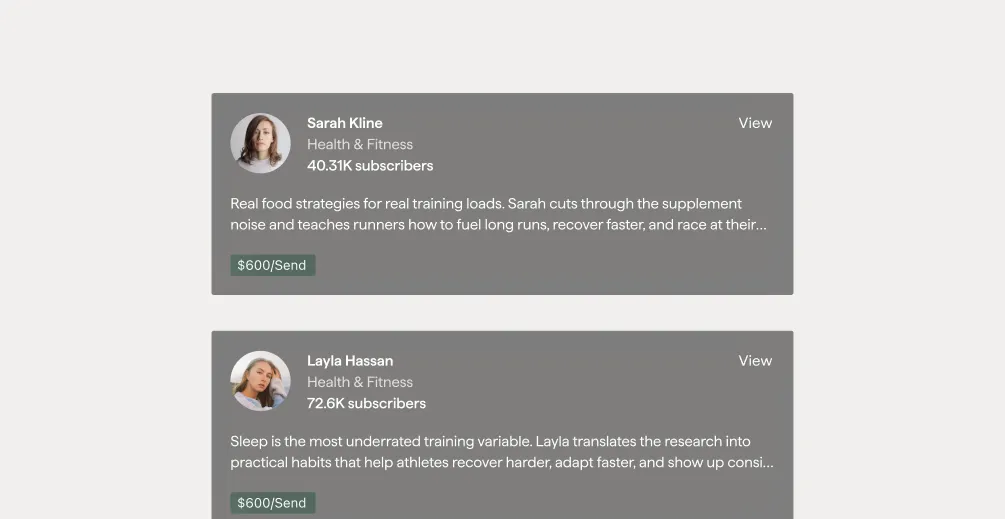
He didn't pitch an advertiser. He didn't negotiate a rate over email. He didn't build a media kit. He didn't track an invoice. What he did instead was build a publisher profile inside Amplify — his audience size, the topics his subscribers cared about, the kind of broadcasts he sent, and the price he wanted for a sponsored block. Amplify handled the rest: the request, the copy collaboration, the payment, the delivery, and the verification that the email actually shipped.
The promotion he wrote
The first sponsorship he ran was for an offer adjacent to his life-hacking content but not competitive with it. The advertiser supplied the offer details. The publisher wrote the promotion himself, in his own editorial voice.
He didn't write the sponsored block as advertising. He wrote it the way he wrote everything else in his newsletter — with context, point of view, and a reason a person already reading him would care. The result: 1,688 unique clicks. 11,933 total click events. A 1.5% click-through rate. The audience didn't experience the promotion as advertising. The publisher's craft turned a sponsorship into something that looked like the rest of his newsletter.
What Amplify did that the publisher didn't
The publisher's job was the editorial work. Amplify's job was everything else: the advertiser's request appearing in the publisher's dashboard, the copy collaboration, the payment at the listed rate with no invoicing, the delivery, and the verification. Both sides could see that the email had been sent, to which audience, and on what date.
This is the lifecycle that, in every other corner of the email economy, is the reason publishers don't run sponsorships. It is paperwork-heavy, trust-dependent, and full of friction. Inside Amplify, it is one of the things you stopped having to think about the moment you turned the directory on.
The buyer-network distinction
The 110,000 people on this publisher's list are not cold leads. They are people who opted in to one Kajabi expert's content and have been reading him for years. Amplify reaches actual buyers — people who've already paid experts. That is the buyer-network distinction. When an advertiser features their offer in this publisher's nurture sequence, they are getting a peer-level introduction to an audience that already trusts a related expert. The 1.5% click-through rate is what that introduction produces.
What he learned about writing sponsored blocks
He wrote in his voice. He gave context — a specific connection to the kind of life-hacking content his audience was already reading. He didn't bury the offer. He didn't oversell. The audience trusts him because his editorial doesn't pile on adjectives. The sponsorship inherited that trust by inheriting the tone.
What he's already planning
Three weeks after his first sponsorship, he had already added Amplify as a regular line item in his publishing schedule. The audience was always there. Now he has a way to share it with experts whose offers fit, and get paid for the introduction.
If you don't know Amplify, you don't know Kajabi.
See Amplify in action → kajabi.com/amplify